
Arab Canada News – News for the Arab Community in Canada
News
Boyleaver demands Carney reveal Gordie Howe Bridge deal: Contradictory statements about what Canada has offered
The Conservative leader asks about the nature of profit-sharing and Washington's authority over tariffs, while the Prime Minister confirms that Canada will not share revenues before fully rec
Published: July 17, 2026
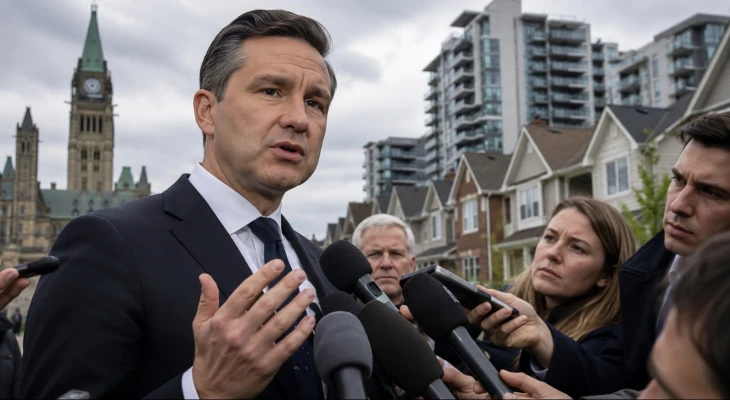
Conservative Party leader Pierre Poilievre escalated his pressure on Prime Minister Mark Carney, demanding the full details of the agreement the government made with the United States to allow the opening of the Gordie Howe International Bridge between Windsor and Detroit.
Poilievre said Canadians received conflicting statements about the concessions Ottawa made, questioning why the new agreement has not been published, and whether the United States obtained a portion of the bridge's revenues or additional influence in setting crossing fees.
The bridge is scheduled to open to traffic on July 27, after its previous date was postponed amid a dispute with the administration of U.S. President Donald Trump regarding financial arrangements and toll management.
Trump had announced that his administration secured a "much better deal" for the United States, while American politicians said their country moved from receiving no revenues to benefiting from a significant share of the bridge's profits.
In contrast, Carney confirmed that the basic agreement signed between Canada and the state of Michigan in 2012 has not changed, and that Canada will continue to collect toll revenues until all debts are repaid and the funds it paid to finance the project are recovered.
He added that any sharing with the American side will not begin before the full recovery of the Canadian investment, and that what will be divided later is the net remaining revenues after deducting the costs of operating the bridge, maintenance, snow removal, and other expenses.
Under the announced arrangements, the American portion of the profits will be allocated to a 15-year regional economic development fund aimed at financing projects that benefit communities on both sides of the border.
Poilievre: What Has Actually Changed?
Poilievre said Carney’s statements do not clearly align with the American statements that portrayed the agreement as a new gain for the United States.
He added that the government cannot say the original agreement remained unchanged, then simultaneously announce a new profit-sharing fund and arrangements granting the American side a role in some toll decisions.
The Prime Minister was asked to clarify whether Canada agreed to transfer half of the net profits from the bridge to the regional fund, and whether this will happen only after full recovery of the project costs or at an early stage of operation.
He also demanded to know the expected amounts to be transferred, how they will be distributed between Canada and the United States, and the entity that will select the projects benefiting from the fund.
Poilievre said publishing the agreement is the only way to end the debate, considering that Canadians should not rely on scattered statements from officials to determine what was negotiated on their behalf.
Canada Fully Funded the Project
The Canadian government funded the construction of the bridge, border facilities, and connecting roads, including key parts of the infrastructure inside the state of Michigan, after the American side refused to bear the project costs.
The original plan stipulated that Canada would recover its expenses from toll revenues, while ownership of the bridge is jointly held by Canada and the state of Michigan.
The Windsor–Detroit Bridge Authority, a Canadian federal entity, oversees the operation of the crossing, sets the tolls, and collects them.
The Conservatives are demanding the government provide a full account of the final project cost, the expected timeframe for recovering the funds, and the impact of the new agreement on the debt repayment schedule.
The dispute mainly focuses on the difference between total toll revenues and net profits; toll revenues are first used to cover debts and operating costs, while net profit appears only after fulfilling those obligations.
Carney says net profits in the early years will be limited, meaning the amount the United States might benefit from will be small, especially if sharing does not begin until after full repayment of the Canadian investment.
American Authority to Adjust Tolls
The government announced that the bridge authority will cooperate with the United States regarding toll adjustments and will seek its approval for some changes that are not directly related to market conditions.
This clause raised additional questions about the extent of the new authority Washington has obtained, and whether it can block toll increases Canada might need to accelerate cost recovery.
Available information indicates that the United States may be able to object to large increases exceeding a certain level, but the full legal text defining these powers has not been published.
The Conservatives say granting the United States the right to approve some tolls could affect Canada’s control over an asset it fully funded, even if the bridge authority remains officially responsible for setting prices.
The government presents the arrangement as a mechanism for cooperation and transparency, not a transfer of control over the bridge or its revenues.
The Government Defends the Agreement
The government says the agreement removed obstacles to opening a vital trade crossing without sacrificing Canada’s right to recover the funds it invested.
The Windsor–Detroit corridor is the busiest commercial land crossing between Canada and the United States, relied upon by the automotive, manufacturing, agriculture sectors, and supply chains in both countries.
The new bridge is expected to provide a direct connection between Ontario’s Highway 401 and Michigan’s Highway 75, reducing congestion and truck wait times at the border.
The government believes that further delaying the opening would have caused losses to businesses and workers and prevented the use of infrastructure completed at huge cost.
But Poilievre said the importance of opening the bridge does not justify keeping the agreement secret, stressing that the opposition does not object to operating the crossing but demands to know the price the government paid to obtain Washington’s approval.
The central question remains whether the new arrangements are merely a limited share in future profits after Canada recovers its funds, or if they grant the United States financial and administrative rights it did not have under the original agreement.
Until the full documents are published, the debate will continue between a government that describes the agreement as protecting taxpayers’ money and ensuring the bridge’s opening, and an opposition accusing it of making undisclosed concessions and presenting contradictory narratives about the deal’s content.











Friday, 17 July 2026
Loading...
--°C
--°C
- --%
- -- kmh
- --%