
Arab Canada News – News for the Arab Community in Canada
News
Trump's tariffs may bring interest rate cuts back into Bank of Canada forecasts despite expectations of a hold
Bank of Montreal excludes raising interest rates during the current year and warns that the escalation of the trade war may weaken growth and push the central bank to ease again.
Published: July 22, 2026
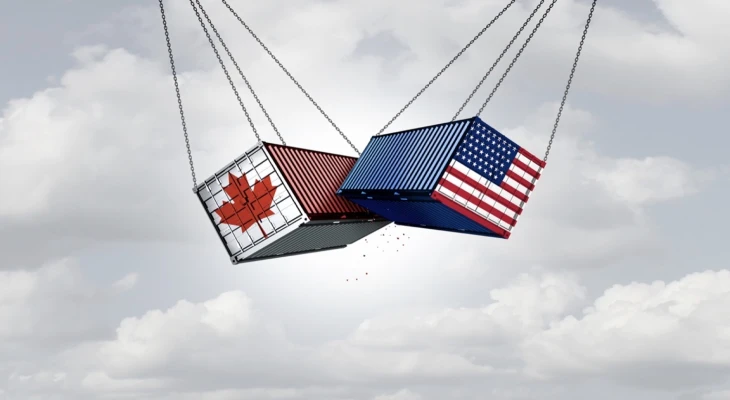
The new US tariffs on Canadian exports have reinforced expectations that the Bank of Canada will stay away from raising interest rates for the remainder of the year, amid warnings that further trade escalation could bring the option of cutting rates back to the table for policymakers.
Bank of Montreal sees the Bank of Canada as being in a "firm hold" position, after the administration of US President Donald Trump announced a 50% tariff on a selected group of Canadian products starting August 19, 2026.
Chief economist Robert Kavcic said that any decision to raise rates after recent developments requires very careful study, given the risks that tariffs may impose on exports, investment, and economic activity.
He added that a further deterioration in trade relations could open the door to a return to rate cuts if the repercussions begin to weaken growth and the labor market at a pace that exceeds the inflationary risks resulting from the tariffs.
Rate hold remains the base scenario
Bank of Montreal does not currently expect the Bank of Canada to move directly to cut rates, as its base scenario remains to keep the interest rate unchanged until the end of the year.
The central bank had kept the key interest rate steady at 2.25% in its last meeting, for the sixth consecutive time, after data showed a relative slowdown in inflation, alongside continued uncertainty surrounding the economy and trade with the United States.
The hold stance reflects an attempt to balance between two conflicting directions: on one hand, tariffs and trade disruption could slow growth and increase unemployment, supporting rate cuts; on the other hand, tariffs may raise the costs of goods and production inputs, adding inflationary pressures and making monetary easing more complicated.
However, the recent US escalation has clearly reduced the chances of a rate hike, even if some inflation indicators remain above the target level.
$28 billion worth of exports under threat
The US measures include Canadian products whose annual exports to the United States are estimated at about 28 billion Canadian dollars, equivalent to nearly 20 billion US dollars.
The list includes alcoholic beverages, cement, dairy products, lumber, paper, chemicals, plastics, electronics, and some machinery and industrial equipment.
In contrast, energy, potash, critical minerals, and fish were excluded, along with products already subject to separate sectoral tariffs.
The targeted goods represent about 5% of Canada's total merchandise exports to the US market, and about 0.8% of Canadian GDP.
Although this percentage alone does not indicate a broad shock encompassing the entire economy, the impact of the tariffs may exceed the direct value of exports due to the connection of affected sectors with suppliers, workers, investments, and transportation and distribution chains.
Tariffs include goods covered by the trade agreement
The danger of the US decision stems from the fact that the new tariffs can be applied even to products that meet the rules of the Canada-United States-Mexico trade agreement.
Goods compliant with the agreement had so far enjoyed exemption from most general tariffs, unless subject to independent sectoral measures.
By bypassing this exemption, companies can no longer rely to the same extent on the agreement to protect their access to the US market, increasing uncertainty about the future of trade within North America.
This may prompt some companies to delay investment, reduce production, or reconsider the locations of their operations and supply chains, even before the full impact of the tariffs appears in export and growth data.
Potential blow to Canadian growth
Preliminary economic estimates indicate that the continuation of tariffs could subtract between 0.3 and 0.6 percentage points from Canadian economic growth over the next year.
The impact may be closer to the lower end of this range if companies succeed in diverting some of their exports to other markets, if US importers absorb some of the cost, or if the two governments reach a settlement reducing the tariffs.
If the measures persist for a long time and expand in scope, losses may worsen through declines in production, employment, and investment, as well as a drop in business and consumer confidence.
Sectors where US buyers can quickly find alternatives to their products are expected to be more exposed to damage, as price increases resulting from tariffs may lead to a direct decline in demand for Canadian exports.
Previous experiences in the iron and steel sectors have shown that exports can sharply decline when tariffs push US buyers to reduce their orders or seek alternative suppliers.
Rush to export goods before the deadline
Canadian companies may seek to accelerate their shipments before the tariffs take effect on August 19, aiming to deliver as much goods as possible to the United States before their costs rise.
This rush may lead to a temporary increase in export figures during the weeks preceding the implementation of the tariffs, followed by a sharp decline after they start.
Therefore, trade data during August and September may become more volatile than usual and the first months may not provide a complete picture of the lasting economic impact.
The broader repercussions are expected to become clearer during the last months of the year, as companies adjust to lower demand and reassess production, employment, and investment plans.
Rate cuts are not an automatic decision
Although weak growth usually supports rate cuts, tariffs place the Bank of Canada before a more complex equation.
If tariffs cause an increase in the prices of imported goods or push companies to pass higher production costs to consumers, the bank may face inflationary pressures at the same time the economy slows down.
In this case, the central bank will need to determine whether the price increases are temporary and confined to certain goods, or if they have started to spread more broadly and affect inflation and wage expectations.
If the effect of weak exports, investment, and employment dominates, while inflation remains under control, the justification for rate cuts will become stronger.
Thus, tariffs do not mean that rate cuts are imminent, but they have made a return to monetary easing more likely than before the escalation.
Direct impact on borrowers and the housing market
Any change in the Bank of Canada's path will have a direct impact on households and businesses, especially those with variable-rate mortgages and those preparing to renew their loans.
Continuing the hold means borrowing costs remain at current levels, while a later rate cut could ease variable payments and gradually affect new loan rates.
However, the economic weakness resulting from the trade war may simultaneously limit the housing market's benefits if it leads to declines in employment, income, and buyer confidence.
Businesses will also be affected through financing costs and demand for their products; while lower rates may help ease financial pressures, they will not fully compensate for the loss of competitive access to the US market.
Markets await negotiation outcomes
Financial markets initially showed a limited reaction, with a slight decline in the Canadian dollar's value and no radical change in interest rate expectations.
This calm reflects investors' belief that the 30-day grace period may allow a settlement before the tariffs take effect, or that the measures may be used as leverage in trade negotiations.
However, continued uncertainty may increase volatility in the Canadian dollar and bond yields, especially if additional threats are issued or companies begin announcing production and job cuts.
Markets will closely watch developments in talks between Ottawa and Washington, alongside inflation, employment, and GDP data, to determine whether the Bank of Canada will maintain the hold or be forced to act.
For now, keeping the rate at 2.25% remains the most likely scenario, but the trade escalation has significantly weakened the chances of a hike and brought rate cuts back into the realm of possibilities if tariffs shift from a negotiating threat to a long-term shock to the Canadian economy.
The current interest rate and the latest hold decision, the scope of the tariffs and their effective date, and estimates of their impact on Canadian growth have been verified.













Wednesday, 22 July 2026
Loading...
--°C
--°C
- --%
- -- kmh
- --%