
Arab Canada News – News for the Arab Community in Canada
News
Ford describes Trump's threat to impose tariffs over wildfire smoke as "nonsense"
Ontario Premier rejects Canada's negligence accusation, calls on Washington for help instead of threats, and proposes canceling Canadian lumber tariffs
Published: July 20, 2026
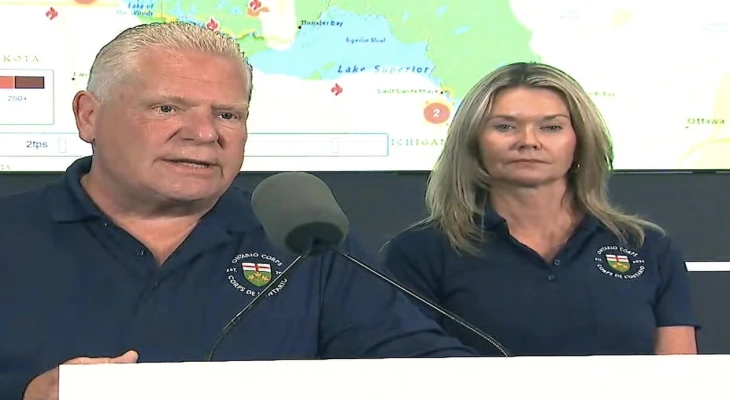
Ontario Premier Doug Ford rejected US President Donald Trump's threat to impose additional tariffs on Canada due to wildfire smoke drifting into the United States, describing the proposal as "nonsense" that does not reflect the extent of efforts made to control the fires and protect affected communities.
Ford said that blaming Canada for cross-border smoke and considering the fires a result of deliberate negligence is "completely unacceptable," emphasizing that the province is facing a widespread emergency requiring the deployment of firefighting crews, aircraft, and evacuation operations in remote areas of northern Ontario.
His response came after Trump accused Canadian authorities of mismanaging their forests, saying that the United States is exposed to polluted and unhealthy air due to smoke coming from Canada.
Trump described the situation as "deliberate negligence" and threatened to add what he considered the economic and health costs of pollution to the tariffs already imposed on Canadian imports.
After meeting with Prime Minister Mark Carney on the sidelines of the World Cup final in New Jersey, the US president said Canada must do more to control the fires, suggesting that it pay compensation or face new tariffs.
However, the US administration has not yet provided a legal mechanism or economic calculation explaining how the cost of the smoke would be determined or linked to customs duties on Canadian goods.
Ford: Send help instead of criticism
Ford said the natural response between the two neighboring countries should be based on cooperation and resource sharing, not accusations and threats of economic sanctions.
He added that if the United States were facing fires of the same size, Canadian teams would have headed south to support American firefighting crews, as happened in previous crises and disasters on both sides of the border.
He stressed that fires do not stop at political borders, and smoke can travel long distances depending on wind direction and weather conditions, whether the fires start in Canada or the United States.
He called on American politicians who criticize Canada to provide aircraft, equipment, and firefighting teams, instead of limiting themselves to what he described as political comments from outside the danger zones.
Proposal to cancel wood tariffs
Ford linked the debate over forest management to the ongoing trade dispute over Canadian lumber, saying Trump should cancel tariffs imposed on softwood exports to the United States.
He explained that increasing the capacity of Canadian companies to cut trees and sell lumber to the US market could help remove some of the accumulated plant fuel inside some forests, in addition to providing jobs and supporting the forestry sector in northern communities.
Removing trees alone does not represent a comprehensive solution to wildfires, as prevention requires a mix of vegetation management, controlled burning, road maintenance, lightning monitoring, and investment in response teams and aircraft.
But Ford used the lumber file to highlight what he considered a contradiction in the US position; Washington demands Canada clean its forests while imposing tariffs that hinder the sale of Canadian lumber in the US market.
Widespread fires and evacuations
Ontario is facing a severe wildfire season, especially in remote northwestern areas where many depend on aircraft and boats for transportation and evacuation operations.
The fires have led to the evacuation of thousands of residents from Indigenous communities and northern towns, while homes and facilities have been destroyed and roads and railway lines closed in areas approached by the fires.
Ford said his government will not set a spending cap necessary to protect residents, and that the priority is saving lives, evacuating communities, and supporting those affected.
The province also announced plans to spend about $650 million to purchase 11 new aircraft, including six water-dropping planes and five helicopters, aiming to modernize the wildfire fighting fleet and enhance response capacity during upcoming seasons.
However, buying new aircraft will not provide an immediate solution to the current fires, as manufacturing, delivery, and commissioning may take time, while the province currently relies on its fleet and aircraft and resources received from other provinces and countries.
Internal criticism of Ontario government
Ford's defense of his government's response came as the province faces internal criticism regarding the level of preparedness for the season, core funding allocated for firefighting, and shortages of some workers and equipment.
The opposition and some northern community leaders say previous decisions related to resources and hiring have left firefighting teams under increasing pressure, and that some evacuations began with local initiatives before sufficient government assistance arrived.
Ford responds that the budgeted amount is not the final spending limit, and that the province usually spends additional amounts depending on the severity of the season and the number of fires.
The government confirmed the deployment of dozens of aircraft and more than 150 firefighting crews, in addition to requesting assistance from the federal government and armed forces in evacuation and air transport operations.
Carney highlights the scale of Canadian response
Meanwhile, Prime Minister Mark Carney confirmed that more than 5,300 firefighting and emergency response personnel are involved in combating fires across the country.
He pointed to the use of satellite images, thermal data, and early monitoring technologies to track fire development and identify the most vulnerable areas.
The federal government says Canada and the United States have been linked for decades by agreements to exchange firefighting teams, aircraft, and equipment, and that the two countries have benefited from this partnership during major fires on both sides of the border.
Canadian officials also emphasize that the increasing intensity of fires and the length of their seasons are linked to rising temperatures, drought, and changing climate conditions, not just forest management methods.
Tariffs turn into a new pressure tool
Trump's threat comes amid a broader trade dispute between the two countries, during which the US administration has used tariffs to pressure Canada on multiple issues.
Turning wildfire smoke into a new justification for imposing tariffs could expand the dispute from traditional trade issues to cross-border natural and environmental disasters.
There are no indications that Washington has started an official procedure to calculate smoke damages or impose a specific tariff, so Trump's statements currently remain a political threat without executive details.
Ford believes the most effective response is not to punish Canadian products, but to coordinate fire response, share resources, address causes of drought and heat, and remove trade barriers facing the forestry sector.
While smoke continues to affect air quality in Canadian and American cities, the debate has shifted from managing a shared health and environmental crisis to a new political confrontation over responsibility, compensation, and customs duties.











Tuesday, 21 July 2026
Loading...
--°C
--°C
- --%
- -- kmh
- --%