
Arab Canada News – News for the Arab Community in Canada
News
Conservatives condemn Trump's tariffs and accuse the Carney government of neglecting Canada's negotiating cards
The opposition demands Washington to immediately withdraw the new tariffs, saying that the liberals failed to secure the trade agreement they promised and withheld the details of the negotiat
Published: July 20, 2026
The Canadian Conservative Party condemned the new tariffs announced by U.S. President Donald Trump on a wide range of Canadian goods, describing them as an unacceptable and unjustified attack on Canadian workers and businesses.
At the same time, the party placed part of the responsibility for the deterioration of the trade situation on Prime Minister Mark Carney's government, accusing the Liberals of abandoning Canada’s leverage and failing to act with the speed and transparency required by the crisis.
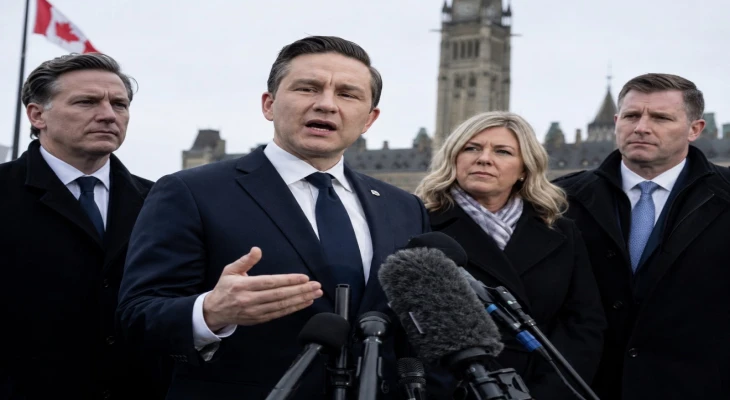
The Conservatives’ position came in a joint statement issued by Shadow Minister for Canada-U.S. Relations Chavalloy Majumdar, Shadow Minister for Foreign Affairs Eric Duncan, Shadow Minister for International Trade Stephanie Kozi, and Conservative Deputy Leader in Quebec Pierre Paul-House.
The statement said the new U.S. tariffs will increase Canadians’ concerns about the future of their jobs and businesses, emphasizing that workers and companies in Canada should not become a "punching bag" in the political and trade disputes of the U.S. administration.
The Conservatives called on Trump to immediately reverse the decision, stressing that targeting Canadian sectors cannot be justified by existing political or trade disagreements between the two countries.
50% Tariffs on Canadian Goods
The U.S. administration had announced imposing a 50% tariff on a group of Canadian exports, in a move it said was in response to Canadian practices it considers discriminatory against American cars, alcoholic beverages, and dairy products.
The announced list includes various industrial and consumer products, including vehicles and their components, some dairy and alcohol products, furniture, clothing, textiles, and machinery.
The tariffs are scheduled to take effect on August 19 and will target Canadian goods with a value of about 20 billion dollars in U.S. imports last year.
However, the tariffs exclude key sectors, including energy, potash, fish, and some vital minerals, which limits their overall scope but does not reduce their potential impact on companies and workers linked to the targeted products.
Trump used Section 338 of the U.S. Tariff Act of 1930 to impose these tariffs, a legal tool rarely used, which allows the president to impose tariffs on countries he sees as discriminating against U.S. trade.
Conservatives: Trump is Wrong and Carney Failed
The Conservative statement made a clear criticism of the U.S. president, affirming that he is wrong in targeting Canadian workers and that he must cancel the tariffs without delay.
But the party did not stop at condemning Washington; it also launched a direct political attack on Carney and his government, considering that the Liberals did not use Canada’s economic and negotiating leverage to reach an agreement that protects its interests.
The Conservatives said Carney described the collapse of the economic relationship with the United States about 14 months ago as the most serious economic crisis Canada has faced since World War II.
They added that this description was accurate, but the government, in their opinion, did not deal with the crisis with the required level of urgency and decisiveness.
The statement accused Carney of retreating from Canadian leverage in recent times without obtaining the comprehensive agreement he promised to secure.
It also said the Liberals failed to provide Canadians with a clear explanation regarding the course of negotiations, the concessions made, and the demands that remain disputed with Washington.
These accusations remain part of the opposition’s political stance, while the government says the complex negotiations with the United States require balancing the protection of Canadian sectors with avoiding an escalation that could cause greater harm to the economy.
Washington Accuses Canada of Discrimination
The U.S. administration justified the new tariffs by saying that Canada imposed restrictions and policies that harmed the ability of American companies to compete within the Canadian market.
Among the issues mentioned by Washington were restrictions on the sale of some American alcoholic beverages, the quota and tariff system related to the dairy sector, and the trade treatment of American vehicles.
The U.S. Trade Representative also accused Canada of taking retaliatory measures against previous American tariffs instead of addressing what Washington considers imbalances in the trade relationship.
The U.S. administration says the tariffs aim to pressure Ottawa to cancel the measures it describes as discriminatory and to open the Canadian market more broadly to American products.
But the Canadian government rejects this characterization, affirming that its measures were a proportionate response to preceding American tariffs, and that many Canadian policies comply with the commitments stipulated in the Canada-United States-Mexico Free Trade Agreement.
Carney Rejects the Accusations
Prime Minister Mark Carney rejected the accusation that Canada practices trade discrimination, affirming that Ottawa acted within its legal and trade rights in response to the American tariffs.
He said Canada remains ready to reach a diplomatic and negotiating solution but will defend its workers, companies, and affected economic sectors.
The government faces increasing pressure from provinces, industry representatives, and unions to reveal a clear strategy for response, whether through imposing counter-tariffs, providing direct support to companies and workers, or intensifying negotiations with Washington.
The government has not yet announced a comprehensive retaliatory response to the new decision, while it studies the impact of the tariffs and the details of the included products and announced exemptions.
Delaying the tariffs’ implementation until August 19 may lead to a new round of negotiations but leaves Canadian companies with a short period to prepare for the possibility of a significant increase in the cost of entering the U.S. market.
Accusations of Withholding Information
The Conservative statement focused particularly on the issue of transparency, accusing the government of not clarifying what has been achieved in the negotiations or the nature of the concessions Canada made.
The party said the Liberals resorted to attacking the opposition instead of answering questions related to the future of the trade agreement and the tariffs imposed on steel, aluminum, cars, and other products.
The Conservatives believe the government should more clearly disclose its negotiating goals, the lines it will not cross, and the job protection plan if the tariffs continue or expand.
On the other hand, governments usually argue that publishing detailed information about ongoing negotiations can weaken their position and give the other party information about their limits and options.
However, the widening scope of the dispute and its extension for more than a year increases parliamentary and public demands for more disclosure about the results the government has achieved and the costs borne by the economy.
A Crisis Beyond the New Tariff Round
The new tariffs do not represent a separate dispute but come within an ongoing trade confrontation between the two countries that has included steel, aluminum, cars, lumber, and a number of agricultural and consumer goods.
They also coincided with the review of the North American Free Trade Agreement, amid disagreements about the future of the agreement, rules of origin for cars, dairy sector management, and trade with China.
The United States had refrained from agreeing to extend the agreement for a new term, putting the three countries into a phase of annual reviews and uncertainty, although the agreement remains in effect for now.
Large sectors of the Canadian economy depend on the U.S. market, especially the automotive, energy, minerals, agriculture, and forestry industries, while American companies and factories in turn depend on Canadian raw materials and components.
Therefore, tariffs can increase production costs and prices on both sides of the border, rather than limiting their effects to Canadian exporters alone.
Conservatives Promise to Confront the Tariffs
The Conservatives said they will continue to pressure in defense of workers, companies, and Canada’s sovereignty and economic unity.
They added that the government should have acted from the beginning of the crisis to protect Canada’s negotiating leverage, diversify markets, support vulnerable industries, and respond more decisively to American measures.
But the statement did not provide new details regarding the type of response the party is now calling on the government to take, or whether it calls for similar counter-tariffs on American goods.
The Conservatives had previously called for reciprocal responses, using tariff revenues to support affected workers and companies and provide tax reductions, rather than diverting funds to general government spending.
These developments place the government and opposition before a difficult equation: showing firmness in facing Washington without igniting additional escalation that threatens jobs, supply chains, and investment.
While both sides agree that Trump’s tariffs are unjustified and must be canceled, the internal political dispute revolves around the responsibility of Carney’s government, and whether it managed the crisis in the best possible way or wasted opportunities and leverage that could have been used to secure a better agreement for Canada.











Tuesday, 21 July 2026
Loading...
--°C
--°C
- --%
- -- kmh
- --%