
Arab Canada News – News for the Arab Community in Canada
News
BC MLA calls for clear funding pathway to implement Sumas Plains flood protection plan
The federal-regional agreement allocates up to $20 million for planning activities, while local communities demand guarantees for the transition to the construction phase
Published: July 22, 2026
Conservative MP Brad Vis continues to pressure the federal government to clarify how the flood risk reduction plan in the Sumas River Basin will move from the study and design phase to the implementation of protection projects on the ground.
The MP for Mission–Matsqui–Abbotsford said that the agreement signed by the governments of Canada and British Columbia represents an important step, but it does not yet provide the financial certainty required to fund the infrastructure the region will need to protect itself from future disasters.
The two governments announced on July 2, 2026, the "Canada-British Columbia Cooperative Prosperity Agreement," which includes a federal contribution of up to $20 million during the 2026–2027 fiscal year to fund joint planning and initial management of flood mitigation projects.
The funding is subject to government approval of the projects and the signing of an executive agreement, and it is supposed to be provided on a cost-sharing basis with the government of British Columbia.
Funding does not yet include construction
The current commitment focuses on studies, design, integrated planning of infrastructure and environment, and managing the initial phases of the project, aiming to prepare projects that become ready for implementation.
However, in its current form, it does not represent a full federal commitment to fund the construction of pumping stations, dams, barriers, drainage networks, or other facilities that the final plan may adopt.
Vis is urging the government to specify the path that ready projects will follow to obtain federal construction funding, warning that municipalities and First Nations cannot continue indefinitely to spend resources on engineering and design work without knowing whether the funds needed for implementation will be available.
He said local partners need assurances that the federal government will soon provide a practical mechanism to move from planning to construction.
Expected confirmation of British Columbia’s contribution
Vis has contacted the Ministry of Housing, Infrastructure, and Canadian Communities to obtain clarifications regarding the commitments outlined in the agreement.
He requested confirmation that the government of British Columbia will provide a contribution matching the federal funding allocated for planning, alongside identifying the federal body responsible for protective infrastructure, and explaining the mechanism through which subsequent funding for actual projects can be obtained.
According to the statements he received, the provincial government is expected to match the federal contribution allocated for planning work, while the Ministry of Housing, Infrastructure, and Communities will take on the role of the main federal body in the file.
However, the amount of funding that may be allocated later for construction, its timing, and the share of each level of government have not yet been finalized.
Partnership between the province, municipalities, and First Nations
The Sumas River Basin plan is based on a cooperative framework bringing together the government of British Columbia, the cities of Abbotsford and Chilliwack, along with the Semath, Matsqui, and Leq’á:mel First Nations.
The partners are working to develop a comprehensive plan that reduces flood risks, develops response and emergency systems, and protects communities and agricultural lands, alongside restoring ecosystems and natural habitats in the region.
The federal government has joined the planning funding efforts through the new agreement, at a time when some proposed solutions require coordination among multiple levels of government, as well as cooperation with U.S. authorities due to the cross-border nature of the river and water systems.
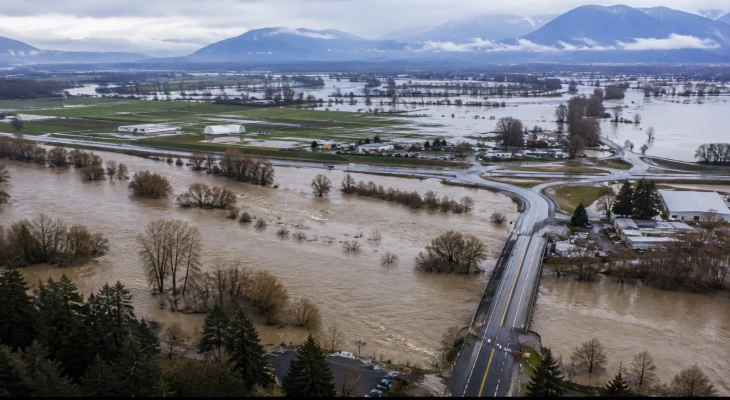
The Sumas Plain and surrounding areas were exposed to devastating floods in November 2021, before the region experienced a new wave of floods and heavy rains in late 2025, renewing concerns about the current infrastructure’s ability to handle future disasters.
Protecting agricultural lands and food security
The Sumas Plain is one of the most important agricultural areas in the Fraser Valley, hosting farms and facilities for food production and distribution, alongside roads, railways, and vital infrastructure.
The 2021 floods submerged large areas of farmland, evacuated residents, disrupted farms and supply chains, and closed major roads connecting the Vancouver area to the rest of Canada.
Vis believes that protecting the region is not just a local issue concerning Abbotsford and Chilliwack alone, but is linked to Canadian food security, trade movement, and national infrastructure.
The area includes transportation corridors used by trucks and trains to move goods between the West Coast and inland markets, and it is located near one of the busiest trade crossings between Canada and the United States.
Any large-scale flood could disrupt the movement of goods and damage farms, commercial facilities, roads, and service networks, increasing recovery costs for governments, residents, and businesses.
The province previously provided funding for planning
The government of British Columbia announced in January 2026 the allocation of $3.3 million to support the flood mitigation planning initiative in the Sumas River Basin.
The funding aimed to complete the design and assessment work necessary to develop long-term construction and environmental projects, after the participating parties agreed on a cooperative framework for risk management and ecosystem restoration.
The city of Abbotsford had also studied a range of solutions, including building a new pumping station on the Sumas River and updating protection and drainage systems.
However, the full cost of implementing the final plan is expected to far exceed the initial planning amounts, making federal government participation essential for municipalities and local partners.
Demand for a timeline to move to implementation
Vis welcomes the inclusion of the flood file in the agreement between Canada and British Columbia, but he believes the success of the agreement will be measured by how quickly political commitments are turned into funding decisions and buildable projects.
He said the region has spent years planning since the 2021 disaster, and continuing studies without a clear commitment to the implementation phase could delay the required protection and increase project costs in the future.
The next phase is expected to include completing designs, technical and environmental assessments, identifying priority projects, and developing more accurate cost estimates before submitting detailed funding requests.
Vis confirmed that he will continue to push for the establishment of a clear federal pathway that enables funding for ready projects, so the agreement does not remain limited to studies and initial management.
The main challenge remains agreeing on the size of the long-term financial commitment and cost-sharing between Ottawa, the province, and local authorities, at a time when risks from heavy rains and floods in the Fraser Valley are increasing.
It has been verified that the federal commitment amounts to up to $20 million for planning and initial management, subject to project approval and signing an agreement, and is not yet announced as funding for construction. The cooperative framework also includes three First Nations: Semath, Matsqui, and Leq’á:mel, alongside the province and the cities of Abbotsford and Chilliwack.









Wednesday, 22 July 2026
Loading...
--°C
--°C
- --%
- -- kmh
- --%