
Arab Canada News – News for the Arab Community in Canada
News
Details of the Gordie Howe Bridge agreement reveal profit sharing with Washington for 15 years
Canada will use its share to cover the project cost of 6.4 billion dollars, while the American share is directed to an economic development fund.
Published: July 22, 2026
The Canadian government revealed more details about the agreement it made with the United States to allow the opening of the Gordie Howe International Bridge, after days of ambiguity and political pressure demanding disclosure of the concessions Ottawa made to Washington.
Under the new arrangements, the net revenues generated from operating the bridge will be split equally between the two sides during the first fifteen years, after deducting operating, maintenance expenses, and other costs related to managing the crossing.
Canada will retain half of the net revenues, which it will use to repay the cost it bore to finance the project, amounting to about 6.4 billion Canadian dollars.
The other half will be directed to an economic development fund supporting projects, businesses, and infrastructure on the American side of the Detroit area and the corridor surrounding the bridge.
Profit sharing begins before debt repayment
The new details clarify that sharing the net revenues with the American side will begin during the first fifteen years of operating the bridge, not after Canada fully repays the project’s debts.
This corrects the impression that arose following previous statements by Prime Minister Mark Carney, who said that Canada would not share toll revenues before fully recovering its investment.
The agreement does not mean sharing the total toll fees paid by bridge users, but rather sharing the remaining amount after deducting operating and maintenance expenses. Canada will use its share of this amount to reduce the debt related to building the project.
Thus, Ottawa will receive only half of the net revenues available to repay the cost during the first fifteen years, while the other half goes to the American fund.
What happens after the 15 years end?
After the new profit-sharing period ends, the arrangements outlined in the original agreement signed in 2012 between Canada and the State of Michigan will resume.
Under those arrangements, toll revenues will go to Canada to continue recovering the project costs until its contribution is fully repaid.
The original agreement had placed the full cost of building the bridge, land, and related facilities on the Canadian government, including infrastructure works located on the American side, in exchange for later recovering those expenses from toll fees.
The actual amount the United States may receive during the fifteen years remains unknown, as it will depend on the number of vehicles and trucks using the bridge, the toll level, and the amount of operating and maintenance expenses.
American role in adjusting toll fees
The agreement also includes a new mechanism for cooperation between the Windsor–Detroit Bridge Authority and the American government regarding toll fee adjustments.
The authority will consult with Washington and seek its approval in some cases involving changes not directly related to market conditions.
This point raised questions about the extent to which Canada retains full authority over toll pricing, especially since the ability to set competitive fees is a key factor in attracting truck and car traffic from other crossings.
However, the government says the new procedures focus on transparency and coordination and do not change the ownership of the bridge or the basic agreement signed with the State of Michigan.
Pressure to disclose the agreement
The disclosure of details came after increasing pressure from the Conservative Party, which demanded the government publish the full agreement and clarify the financial implications for Canadian taxpayers.
The Conservatives accused the government of providing unclear narratives about the timing of revenue sharing and how the project’s debts would be repaid, calling for a meeting of the Government Operations Committee in the House of Commons to review the agreement and summon government officials to answer MPs’ questions.
Conservative leader Pierre Poilievre also demanded a full account of what he described as concessions made to the American administration, and whether Canada had relinquished part of the revenues or powers related to setting fees in exchange for Washington’s approval to open the bridge.
It is not yet clear whether the government will publish the full legal text of the agreement or will limit itself to the details it provided regarding profit sharing and toll management.
Agreement followed an American threat to block the opening
The bridge was scheduled to open in June, but the date was postponed after U.S. President Donald Trump threatened to block its operation, objecting to the original financial arrangements that allowed Canada to collect revenues to recover the project’s cost.
After negotiations between officials of the two countries, Ottawa and Washington announced reaching an agreement allowing the bridge to open to traffic on July 27, 2026.
Trump said the new agreement represents a better deal for the United States, while the Canadian government defended it as a practical solution enabling the operation of a vital commercial crossing after years of construction and delays.
A strategic project for trade between the two countries
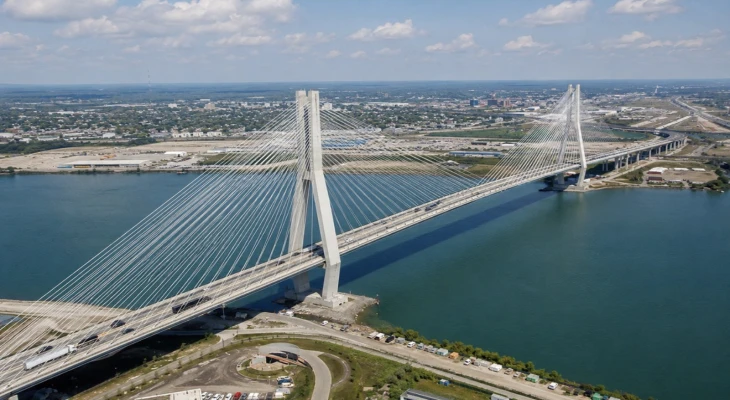
The Gordie Howe International Bridge connects the city of Windsor in Ontario with the city of Detroit in Michigan, consisting of six lanes for cars and trucks, in addition to modern border facilities and a pedestrian and bicycle path.
The bridge is about 2.5 kilometers long, with its main span over the Detroit River reaching 853 meters, making it the longest cable-supported bridge of this type in North America.
The project aims to relieve pressure on the nearby Ambassador Bridge and improve the movement of goods and supply chains for the automotive and other industries through one of the most important trade corridors between Canada and the United States.
Despite the approaching opening date, the bridge has turned from a project meant to symbolize economic cooperation between the two countries into a sensitive political issue amid escalating trade disputes, tariffs, and American pressures on the Canadian government.












Wednesday, 22 July 2026
Loading...
--°C
--°C
- --%
- -- kmh
- --%