
Arab Canada News – News for the Arab Community in Canada
News
Trump's fees put county leaders to a tough test at the Charlottetown meeting
Washington imposes 50% tariffs on Canadian goods worth nearly 20 billion dollars and places a ban on American beverages at the heart of the trade confrontation
Published: July 21, 2026
The premiers of Canadian provinces and territories entered their annual summer meeting in Charlottetown amid a sudden escalation in the trade war with the United States, after US President Donald Trump announced the imposition of new tariffs of 50% on a wide range of Canadian goods.
The US decision puts renewed pressure on the provincial premiers, especially since the US administration included the withdrawal of American alcoholic beverages from provincial stores among the practices it says discriminate against American products.
Most provincial governments had stopped purchasing American beverages or withdrawn them from government stores in response to tariffs previously imposed by Washington on Canadian exports. But this retaliatory step has now become part of the US justifications for a new round of tariffs, placing the provinces before a complex political and commercial equation.
Tariffs on goods worth 20 billion dollars
The new tariffs include Canadian imports to the United States estimated at about 20 billion dollars, equivalent to nearly 5.2% of the total goods imported by the United States from Canada during 2025.
The measures cover a variety of products, including wine, dairy products, cement, furniture, clothing, fishing tools, hockey equipment, swimming pools, and seeds, along with other consumer and industrial goods.
The tariffs are scheduled to take effect on August 19, leaving a limited time window for the two governments to try to reach a settlement or mitigate the scope of the measures before their implementation.
Washington excluded some major Canadian exports, including energy, potash, fish, and critical minerals, in addition to products already subject to separate sectoral tariffs.
However, the new tariffs will apply to targeted goods even when they qualify for preferential treatment under the Canada-United States-Mexico trade agreement, which increases Canadian concerns about undermining the safeguards that the agreement is supposed to provide.
American alcohol returns to the forefront
The US administration linked its decision to what it described as Canadian discrimination against American cars, dairy products, and alcoholic beverages.
It pointed out that Canada's imports of American cars declined by 22% last year, while its imports of American alcoholic beverages dropped by 81%.
But Canadian measures related to alcohol did not start as an independent trade policy; rather, they came in response to previous US tariffs and threats. The provinces used their authority over liquor stores to stop purchasing American products and remove them from shelves, in an attempt to pressure companies and producers inside the United States.
Including this step among the justifications for the new tariffs represents an important shift in the confrontation, as Washington now uses Canadian retaliatory measures to justify further escalation against Canadian exports.
Provincial powers complicate the response
The federal government alone cannot return American beverages to stores because purchasing, distribution, and sales decisions largely fall under the authority of the provinces and their relevant institutions.
This means that any settlement involving the resumption of selling American products will require the cooperation of the regional premiers, who themselves face internal political pressure not to back down before Washington.
Resuming American beverages might be presented as an attempt to reduce tension and protect Canadian exporters, but it might also appear as a concession to American threats, especially after American product boycotts became a symbol of the Canadian stance in the trade dispute.
Maintaining the ban, on the other hand, could be used by the US administration as a pretext to continue or expand tariffs, even though the dispute also involves the automotive, dairy, and broader trade policy sectors.
A meeting dominated by the trade confrontation
The summer meeting of the premiers of provinces and territories is held in Charlottetown from July 21 to 23, with the participation of leaders from all thirteen provinces and territories.
The meetings were expected to address issues of the economy, cost of living, healthcare, major projects, and public safety, but the US escalation placed trade relations with Washington at the top of the agenda.
The leaders are expected to discuss how to maintain a unified Canadian position, coordinate possible measures with the federal government, and determine whether the provinces will continue to ban American beverages or adjust their stance within broader negotiations.
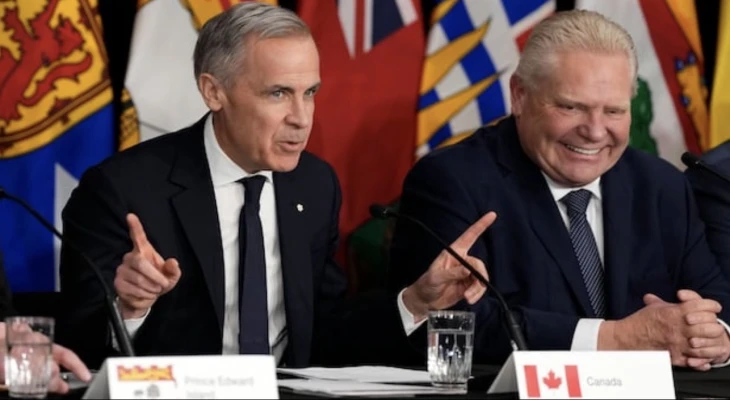
The regional premiers will also meet Prime Minister Mark Carney in Charlottetown on July 23, in a meeting expected to witness intensive discussions about the Canadian response and the potential implications for jobs, investment, and supply chains.
Calls for a similar response
Ontario Premier Doug Ford called for a similar Canadian response if Washington proceeds with implementing the tariffs, demanding to confront US measures on a "dollar for dollar" basis.
Ontario is one of the provinces most exposed to the repercussions of the dispute, due to its large industrial sector's reliance on trade with the United States, especially the automotive industry and its related supply chains.
Meanwhile, the federal government is trying to keep the door open for negotiations, affirming that it has made proposals to address trade disputes and is ready to intensify talks with Washington.
But the US decision narrows the maneuvering space for Canadian leaders, as they must balance protecting threatened sectors, maintaining internal unity, and avoiding a series of retaliatory measures that could raise costs for businesses and consumers in both countries.
A test of Canadian unity
The Charlottetown meeting comes at a moment when unity between Ottawa and the provinces has become a key factor in managing the crisis.
The US administration no longer targets only federal policy but has begun linking its measures directly to decisions made by provincial governments, such as managing liquor stores and procurement policies.
Thus, the trade dispute is no longer an exclusive file between the White House and the Canadian government but has become a test of the ability of different levels of government in Canada to coordinate a joint response.
The decision regarding American beverages will be one of the early indicators of the provinces' direction: either continuing pressure and risking further escalation, or using the issue as a bargaining chip within a broader attempt to contain the trade war before the new tariffs take effect.














Tuesday, 21 July 2026
Loading...
--°C
--°C
- --%
- -- kmh
- --%