
Arab Canada News – News for the Arab Community in Canada
News
Trump imposes new tariffs on Canada and Carney: All options are on the table if negotiations fail
A 10% tariff comes into effect on most Canadian imports alongside a separate threat to impose 50% on specific products starting August 19
Published: July 24, 2026
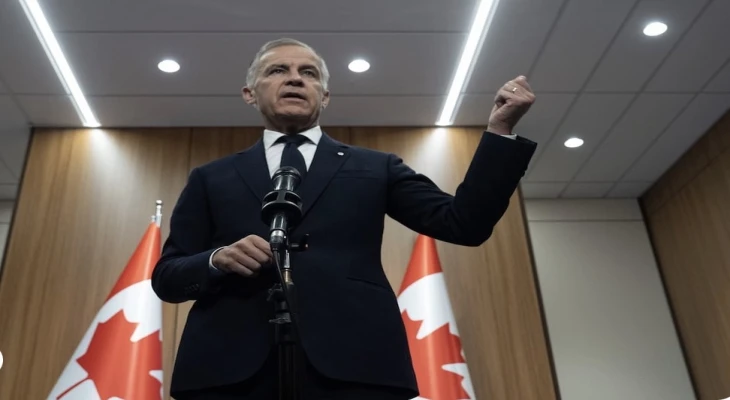
Prime Minister Mark Carney confirmed that Canada is considering all available options to protect its economy and trade interests, after the administration of U.S. President Donald Trump imposed new tariffs of 10% on most Canadian imports, at a time when the country faces a separate threat of tariffs reaching 50% on a range of its exports.
Carney said, following his meeting with provincial and territorial premiers in Charlottetown, that the federal government has intensified its negotiations with Washington in an effort to reach a comprehensive trade agreement, but it will not hesitate to take countermeasures if talks fail.
He explained that "all options are on the table" if no agreement is reached, without specifying the nature of the responses Canada might adopt or the U.S. sectors that might be targeted.
However, he stressed at the same time that taking retaliatory measures before the negotiations end would be premature and could hinder the chances of reaching a settlement in the coming weeks.
New tariffs under the pretext of combating forced labor
The United States imposed additional tariffs of 10% on most Canadian goods entering the U.S. market, as part of trade measures involving 60 U.S. partners.
The U.S. administration justified the decision by what it described as the failure of several countries to effectively enforce a ban on importing products made wholly or partly by forced labor.
Washington acknowledged that Canada has a law preventing the entry of such products, but said that enforcement of the ban remains insufficient, based on the limited number of shipments detained or blocked at the Canadian border.
The tariffs came into effect at 12:01 a.m. Eastern North America time on July 24, 2026, just hours after the final announcement.
The measures do not include all products without exception, as Washington exempted goods already subject to sectoral tariffs under national security provisions, along with a number of raw materials and products that it believes imposing tariffs on could lead to widespread disruptions in the U.S. economy or supply shortages.
This means that products such as certain metals, cars, and spare parts subject to separate customs arrangements will not bear the new tariff on top of existing sectoral tariffs.
A separate escalation of 50%
The new 10% tariffs differ from the other tariffs announced by Trump earlier in the week, scheduled to begin on August 19.
The second package targets a specific group of Canadian exports with tariffs of up to 50%, including products such as alcoholic beverages, cement, dairy, honey, some woods, paper, chemicals, plastics, electronics, industrial equipment, and hockey gear.
The value of exports covered by this package is estimated at about 28 billion Canadian dollars annually, or nearly 5% of the total Canadian goods exports to the United States.
Washington excluded energy, potash, fish, and critical minerals, along with goods already subject to other sectoral tariffs.
The August tariffs raise particular concern in Ottawa because they may apply to goods that previously benefited from preferential treatment under the Canada-United States-Mexico trade agreement.
Thus, Canadian companies currently face two parallel tracks of tariff pressure: a broad 10% tariff related to forced labor issues, and targeted 50% tariffs linked to U.S. disputes with Canadian policies in the automotive, dairy, and alcoholic beverage sectors.
Carney rejects preemptive response
Carney said the government does not need to announce its response before it becomes clear whether negotiations will succeed in preventing or mitigating the tariffs scheduled for August.
He added that the U.S. threat of high tariffs before negotiation dates has become a recurring tactic, noting that Washington usually sets a deadline linked to a major tariff threat to pressure the other side.
The Canadian government believes that announcing retaliatory measures immediately could reduce the negotiation margin and give the U.S. administration a justification for further escalation.
But Carney confirmed that Canada will be ready to act if the tariffs come into effect, and that the government will do whatever is necessary to support affected workers, farmers, businesses, and families.
He also indicated that Ottawa seeks a comprehensive agreement addressing the trade relationship between the two countries, rather than a series of separate understandings concerning each sector individually.
Disagreement among provinces over pressure tools
Despite Canadian leaders emphasizing the importance of maintaining a unified stance, clear differences appeared among the provinces regarding the tools that can be used against Washington.
Ontario Premier Doug Ford called for a similar response to the U.S. tariffs, demanding that Canada meet the new measures "dollar for dollar."
He also did not rule out reusing electricity exports to the United States as a pressure tool, affirming that Ontario has much to lose due to its industries' reliance, especially the automotive sector, on cross-border trade.
In contrast, Alberta and Saskatchewan rejected resorting to restricting crude oil or potash exports, warning that using Canadian resources as a trade weapon could harm producers and workers inside Canada before affecting the United States.
British Columbia Premier David Eby showed greater readiness to consider using critical minerals as a bargaining tool if the federal government requests support from the province.
British Columbia exports minerals such as copper, zinc, and aluminum, which are important materials for U.S. industries and technology, energy, and infrastructure supply chains.
Canada insists on the existence of forced labor ban
The Canadian government said the U.S. measure was not entirely surprising, given the investigations Washington conducted over the past months regarding the policies of dozens of countries related to forced labor.
Ottawa confirmed that it shares with the United States the goal of preventing products made through labor exploitation from entering supply chains.
Canada had banned the import of goods produced by forced labor, in compliance with the provisions of the North American trade agreement, but the U.S. side considers that the number of shipments prevented by Canadian authorities remains limited compared to the volume of trade.
The upcoming talks are expected to focus on how to enhance Canadian enforcement and customs information sharing, and whether Washington is willing to suspend or reduce tariffs in exchange for additional commitments.
The trade agreement enters a more fragile phase
The escalation comes at a time when the trade agreement among the three countries is going through a phase of uncertainty, after Washington refused to extend it automatically for another 16 years.
This does not mean the immediate end of the agreement, but it will remain subject to annual reviews that may continue until 2036, increasing uncertainty for investors and businesses.
The United States is also conducting its negotiations with Canada and Mexico on separate tracks, amid indications of faster progress with the Mexican side.
This raises concerns that Canada may be asked to make similar concessions to any commitments Mexico agrees to, even when economic interests and trade issues differ between the two countries.
Companies fear that repeated reviews and sudden tariffs could undermine the stability of supply chains built on the basis of free movement of goods among the three markets.
Pressure on investment and the Canadian dollar
The effects of the tariffs may extend beyond the directly affected exports, as uncertainty pushes companies to delay investments, expansion, and hiring.
Ontario, Quebec, and British Columbia are among the provinces most vulnerable due to the size of their industrial and export sectors and their connection to the U.S. market.
Canadian companies may face a choice between lowering their prices to absorb part of the tariff, passing the cost on to the U.S. importer, or reducing their exports and seeking alternative markets.
The developments may also increase pressure on the Canadian dollar and growth expectations, and reopen the possibility of interest rate cuts if the trade war begins to weaken economic activity and the labor market.
Diversifying trade is part of the Canadian response
Carney emphasized that Canada will continue working to strengthen its domestic economy and expand its trade relations outside the United States, regardless of the outcome of ongoing negotiations.
The government seeks to accelerate major projects, remove trade barriers between provinces, and increase exports to Europe, Asia, and other countries, aiming to reduce excessive dependence on the U.S. market.
However, shifting trade routes requires time and investments in ports, railways, energy, and infrastructure, while thousands of Canadian companies currently rely on the U.S. market as the closest and largest destination for their exports.
Therefore, reaching a settlement with Washington remains an immediate priority, alongside building long-term alternatives.
With the 10% tariffs coming into effect and the August 19 deadline approaching, the Canadian government faces a critical negotiation period: either reaching an agreement to prevent wider escalation or moving to countermeasures that could open a more intense phase in the trade war between the two countries.












Friday, 24 July 2026
Loading...
--°C
--°C
- --%
- -- kmh
- --%