
Arab Canada News – News for the Arab Community in Canada
News
Canadian officials celebrate the Gordie Howe Bridge before its opening to traffic
The new crossing between Windsor and Detroit will begin receiving cars and trucks on July 27 after eight years of construction
Published: July 24, 2026
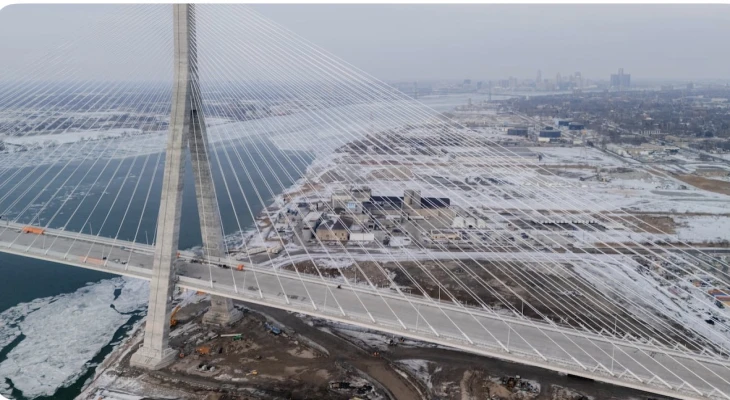
Canadian officials met on Friday in the city of Windsor, Ontario, to hold a special ceremony marking the completion of the Gordie Howe International Bridge, before its official opening to vehicle and truck traffic between Canada and the United States.
The event was attended by Federal Minister of Housing and Infrastructure Gregor Robertson, alongside Ontario Premier Doug Ford, Windsor Mayor Drew Dilkens, local officials, and representatives from the entities involved in the project’s implementation.
The ceremony was held three days before the bridge’s operation begins, as it is scheduled to open to passenger and commercial truck traffic on Monday, July 27, 2026, ending years of construction, testing, and border preparations.
The bridge spans the Detroit River, connecting Windsor in Ontario with the city of Detroit in Michigan, providing a new crossing within one of the busiest land trade corridors between Canada and the United States.
Canadian celebration instead of a bilateral ceremony
Initially, a joint ceremony was planned to bring together Canadian and American officials on the bridge, celebrating the opening of a project representing broad cooperation between the two countries.
However, the Canadian government canceled participation in the bilateral event after the U.S. administration announced new 50% tariffs on a range of Canadian products, considering that holding a joint celebration was no longer appropriate amid the trade escalation.
Ottawa decided to hold a separate Canadian event to celebrate the project’s completion and honor the workers, engineers, and local communities that contributed to its achievement.
Nevertheless, the cancellation of the joint celebration did not affect the opening date, as the concerned parties confirmed that the bridge would begin receiving vehicles as scheduled.
The trade tension cast a shadow over an occasion that was expected to symbolize economic partnership between the two countries, but local officials emphasized that the bridge’s long-term significance will surpass current political disagreements.
Eight years of construction work
Main construction began in October 2018, including building the bridge over the river, two modern border crossings, and a network of roads and intersections that connect the crossing directly to highways in both countries.
Thousands of workers, engineers, and technicians participated in the project, which faced construction and logistical challenges, along with delays partly linked to the COVID-19 pandemic.
The bridge’s opening was initially scheduled earlier but was postponed to complete operational tests and border procedures, then affected by disputes between Ottawa and Washington regarding revenues, crossing fees, and arrangements related to operating the crossing.
In July, the two sides reached a preliminary agreement allowing the bridge’s opening to proceed, while continuing to work on completing detailed legal, financial, and administrative arrangements.
Six lanes and direct highway connection
The bridge includes six lanes for vehicle and truck traffic, with a total length of about 2.5 kilometers.
The main cable-stayed section extends 853 meters without piers within the Detroit River, making it the longest main span of a cable-supported bridge in North America.
The bridge deck rises to about 46 meters above the river’s water at its highest point, allowing uninterrupted ship movement.
The bridge connects directly to Highway 401 in Ontario and Highway 75 in Michigan, providing trucks with a continuous route between the two highway networks without needing to pass through congested local streets.
The project also includes two large border facilities on both sides of the river, equipped with modern systems for vehicle inspection and managing passenger and cargo traffic.
Free pedestrian and bicycle path
The bridge features a multi-use path for pedestrians and cyclists, representing the first crossing of its kind in the Windsor–Detroit area allowing non-motorized travel between the two countries.
The path is scheduled to open on August 5, about a week after vehicle and truck traffic begins.
Pedestrians and cyclists will be able to use it free of charge, subject to travel document requirements and inspection and entry procedures applied at international border crossings.
The path offers wide views of the Detroit River and the two cities, as well as providing a new link for tourism, recreation, and local cross-border mobility.
Relieving pressure on the Ambassador Bridge
The Gordie Howe Bridge provides a new alternative to the Ambassador Bridge, which has been the main truck crossing between Windsor and Detroit for decades.
The Windsor–Detroit corridor is a key hub for the movement of vehicles, agricultural products, industrial and consumer goods between the two countries, with trade worth hundreds of millions of dollars crossing it daily.
The new crossing is expected to help distribute truck traffic, reduce congestion, and increase the region’s capacity to maintain trade in case one crossing is disrupted.
Its direct highway connection offers a more efficient route for trucks and reduces the need to use urban roads to reach border facilities.
Having an additional crossing will enhance supply chains’ ability to cope with incidents, closures, or sudden traffic surges.
A Canadian project worth 6.4 billion dollars
The project contract is valued at about 6.4 billion Canadian dollars, including the design, construction, financing, operation, and maintenance of the bridge, as well as the border facilities, roads, and related intersections.
Canada fully financed the project, including work carried out on the U.S. side, based on gradually recovering costs from toll revenues.
A recent preliminary agreement with the United States sparked political controversy after stipulating that 50% of the net revenues related to the bridge and crossing be allocated to an economic fund managed by the U.S. during the first fifteen years of operation.
The government and opposition still differ on the impact of the new arrangement on the time needed for Canada to recover its investment and how it will be implemented alongside the original agreement signed between Canada and the state of Michigan in 2012.
However, the financial dispute did not change the project’s ownership or the role of the Windsor–Detroit Bridge Authority in managing and operating the crossing.
A name that unites Canada and Detroit
The bridge bears the name of Canadian hockey legend Gordie Howe, who was born in Saskatchewan and whose name became associated with the city of Detroit after a long career with the Detroit Red Wings team.
The name reflects the deep sporting and cultural ties between Canada and the state of Michigan, alongside the trade relations that have made the region one of the most integrated border areas in North America.
The bridge begins operation amid highly tense Canadian–American relations, but officials in Windsor and Detroit hope the project will remain a long-term investment in trade, mobility, and community ties on both sides of the border.
With its opening to traffic on July 27, the Gordie Howe Bridge moves from a project that took years of planning and construction to a new economic artery expected to play a central role in trade between Canada and the United States for decades to come.













Friday, 24 July 2026
Loading...
--°C
--°C
- --%
- -- kmh
- --%