
Arab Canada News – News for the Arab Community in Canada
News
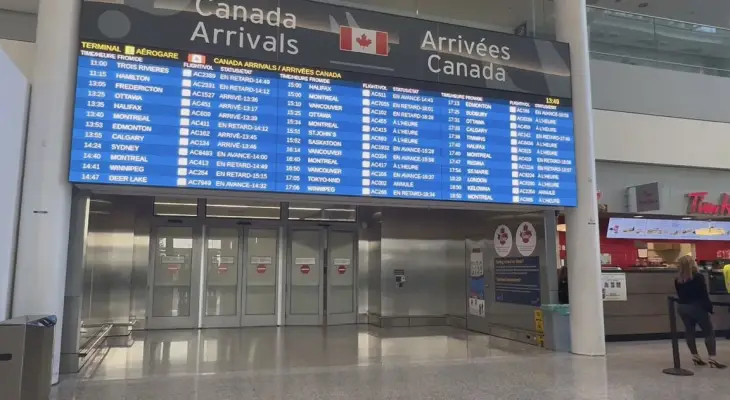
Investigative report reveals security gaps at Pearson Airport that may be exploited by drug trafficking networks
The investigation highlights the weakness of inspection of some workers when leaving restricted areas and the possibility of public access to local baggage belts.
Published: May 20, 2026
Toronto —
A new investigative report revealed alarming gaps in the security system inside Toronto Pearson Airport, Canada's busiest airport, related to how workers with access permits to restricted areas such as aircraft aprons, baggage handling zones, and operational corridors behind checkpoints are monitored.
The investigation focused on a fundamental question: if the average passenger undergoes thorough screening when boarding the plane, do some airport workers’ movements within and exit from sensitive areas undergo the same level of scrutiny?
The findings indicate that the answer is not always reassuring. While passengers are subjected to screening, bag checks, and camera surveillance, former workers and security experts say some employees working in back areas can leave the airport after their shifts without routine regular screening.
A worker in the runway area at Pearson Airport, whose identity was concealed to protect his job, said he has worked in highly sensitive areas for about twenty years but was only screened once when leaving the airport. According to his account, employees can finish their work and exit through terminal doors or head towards transportation and parking areas without regular checks.
This detail is at the heart of the investigation because organized crime networks do not necessarily need to breach passenger screening procedures if they can exploit an insider with direct access to aircraft or baggage.
According to former investigators, the airport’s “front end,” where passengers pass through, is relatively fortified, but the “back door” designated for workers may be less stringent, especially if there are no surprise or periodic exit inspections.
More than 50,000 people work at Pearson Airport, the vast majority of whom are honest employees. However, the investigation indicated that organized criminal groups seek to exploit or recruit a limited number of workers to smuggle drugs through the baggage and aircraft system.
One method highlighted by the investigation involves introducing drug-laden bags at the country of origin, then removing them upon arrival in Toronto with the help of an insider employee before passing through the usual customs route.
Among the vulnerabilities the investigation focused on is the possibility of diverting a bag arriving from an international flight to the local baggage claim area, where there are no customs checkpoints as in international arrival zones, and where members of the public can access the baggage belts.
This issue is not limited to Pearson alone. According to the investigation, other major Canadian airports have local baggage belt areas directly open to the public, raising questions about the current systems’ ability to prevent misuse of these areas.
The investigation also documented cases of some workers entering restricted areas by tailgating behind another employee through security doors without swiping their own access cards, meaning there is no clear electronic record of who entered that area at that moment.
This point raises special concern because relying on access cards is ineffective if they are not actually used every time, or if “tailgating” becomes a repeated and practically accepted behavior.
The Pearson Airport administration confirms that local baggage claim areas are accessible to the public for operational reasons, such as assisting travelers or reviewing baggage service offices, and that there are security patrols and surveillance in these areas. However, it pointed out that investigating drug smuggling is not within the airport authority’s direct jurisdiction.
The Air Transport Security Authority also clarified that its primary mission is to prevent materials that threaten aviation safety, such as explosives and weapons, not to search for drugs per se, although it notifies the police if illegal substances are found during screening.
Here emerges a complex gap in responsibilities: each entity performs part of the task, but the investigation raises the question of whether there is a single entity clearly responsible for preventing insider exploitation of workers to smuggle drugs through airports.
These concerns gain more importance after cases involving Canadians in transporting large quantities of cocaine through international airports, including individuals who later confirmed they were recruited through job offers or social relationships and were unaware of the scale of what was happening.
In one case, a young man said he was close to joining a smuggling network before backing out, explaining that organizers coordinated flights according to the work schedules of specific employees inside the airport. According to his account, bags were made heavier than usual so the complicit employee could recognize them during weighing or sorting, then divert them away from the usual screening path.
Although these allegations always require full judicial and security investigation, they intersect with warnings from former investigators that insider threats have become one of the most dangerous vulnerabilities in modern airports.
Experts believe that the events of September 11 radically changed passenger screening procedures, but the threat related to insider employees has not always received the same level of rigor, especially when it comes to drug smuggling rather than a direct threat to aviation.
The investigation concludes that the problem is not the presence of thousands of employees inside airports, but the lack of sufficient routine exit screening, weak tracking of some entry movements, public access to local baggage areas, and overlapping responsibilities among security, customs, police, and airport management authorities.
These findings open the door to demands for tightening random screening procedures for workers, mandating the use of access cards every time, improving baggage belt monitoring, and enhancing coordination between airport authorities, police, customs, and transport security agencies.
The investigation does not speak of a minor procedural flaw but of a system that, if exploited from within, could become a safe passage for transnational smuggling networks.













Thursday, 04 June 2026
Loading...
--°C
--°C
- --%
- -- kmh
- --%