
Arab Canada News – News for the Arab Community in Canada
News
Ontario court excludes weapon-related evidence after police hit scooter riders in Whitby
The judge considers the use of an unmarked police car in the arrest operation a serious violation of constitutional rights, which led to the dismissal of weapons charges against one of the de
Published: July 16, 2026
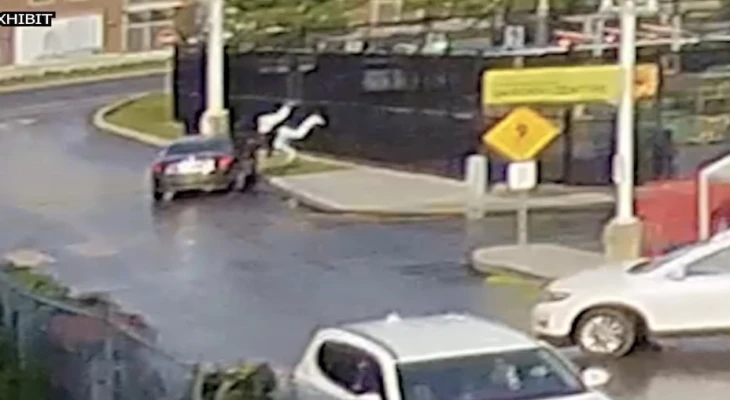
An Ontario court excluded a firearm from evidence in a criminal case after surveillance footage showed a police officer driving an unmarked car and deliberately hitting two men riding an electric scooter during a stop near a Canadian Tire store in Whitby.
Judge Katrina Mulligan found that the way the stop began constituted an unjustified and dangerous use of force and a serious violation of the rights guaranteed by the Canadian Charter of Rights and Freedoms.
The incident dates back to the evening of June 25, 2024, when four Toronto police officers in plain clothes and unmarked cars went to Whitby searching for Trevon Palmer, suspected of violating his bail conditions in a firearm-related case.
The team's instructions were to carry out the stop only if safe and quick conditions were met, ensuring that the person clearly understood that those approaching him were police officers.
Palmer left the house accompanied by Paul Lewis, who was not wanted by the police team and was unknown to the officers at the time. They then rode an electric scooter together toward a commercial plaza that included a Canadian Tire store.
According to the ruling, there was no designated leader for the operation, and communication among the officers was weak and confused.
When one officer indicated via radio that the commercial plaza might be a suitable location to carry out the stop, Officer Joshua Baksh understood the message as an order to move.
Surveillance footage showed Baksh speeding his unmarked car toward the scooter and directly colliding with it, causing the two men to be thrown into the air and fall several meters away.
The judge described the collision as violent and occurring without apparent justification, noting that Lewis was not wanted by the police and that stopping Palmer did not require such an urgent and dangerous intervention.
Weapon drops after collision
After falling, the two men got up and tried to flee before Lewis returned to the collision site and picked up a pistol that had fallen on the ground.
Another officer arrived at the scene in his car and said he saw Lewis running toward him carrying the weapon and believed his life was in imminent danger.
The car collided head-on with Lewis, trapping him between two police vehicles, while the weapon flew from his hand and fell onto the road.
Lewis, who was 18 years old at the time, suffered serious injuries including fractures to the spine and ribs and bruising to the lungs, and was taken to the hospital for treatment.
The judge accepted that the officer in the second collision saw the weapon and believed he faced a deadly threat, but also found that he had decided to block Lewis’s path with his car before seeing the weapon, despite no prior legal basis to stop him.
She considered that using the two cars in this way constituted a coercive means to restrict freedom and exposed the two men’s lives and safety to serious risk.
Violation of constitutional rights
Lewis’s lawyer argued that his client was subjected to arbitrary detention and dangerous and unlawful use of force, violating his right to personal security and his right not to be arbitrarily detained.
The prosecution acknowledged that the first collision constituted a serious violation of the men’s rights but argued that the second action was justified because Lewis was carrying a pistol and approaching the officer.
The judge concluded that the violations were “serious and profound,” and that the vehicles were used in a way that could cause disfigurement or death.
The court rejected the request to halt the criminal proceedings entirely but decided to exclude the weapon from evidence under the Canadian Charter of Rights and Freedoms.
Excluding the weapon effectively led to Lewis’s acquittal on charges related to possession, as no evidence remained for the prosecution to rely on to prove those charges.
The judge explained that the weapon was a restricted type, equipped with a magazine exceeding the legal capacity and loaded with ammunition, describing the spread of such weapons as a serious scourge in communities.
However, she concluded that admitting evidence obtained through serious police violations would cause greater harm to public confidence in the justice system in the long term.
The decision does not mean the court considered carrying the weapon lawful, but rather applied the constitutional rule allowing evidence to be excluded when admitting it, given how it was obtained, would damage the administration of justice’s reputation.
Officer convicted of assault
Ontario’s Special Investigations Unit charged Baksh with dangerous driving and assault with a weapon, considering the car as the instrument in the collision.
The officer was later convicted of assault and is still awaiting sentencing, while Toronto Police kept him in a role that does not involve direct public interaction.
Lewis was only convicted of violating one of his bail conditions and received a suspended sentence and was placed under supervision for six months.
The prosecution also withdrew charges against Palmer.
The judge said the evidence before her was insufficient to determine whether the poor decision-making was due to individual officers, the entire team, or broader practices within Toronto Police.
But she confirmed that hitting a moving scooter carrying a person wanted for bail violation and another unidentified rider does not represent a normal or acceptable police practice.
The case highlights a fundamental principle in Canadian criminal law: the seriousness of the crime or the seized evidence does not grant police unlimited authority, and officers’ violation of constitutional rules may lead to exclusion of strong evidence and collapse of prosecution.









Thursday, 16 July 2026
Loading...
--°C
--°C
- --%
- -- kmh
- --%