
Arab Canada News – News for the Arab Community in Canada
News
Fires under suspicion: Are what is happening accidental incidents or deliberate acts?
Conflicting sources of funding, the hidden owner, and suspicious movements… essential investigation paths that must not be neglected

Published: November 24, 2025
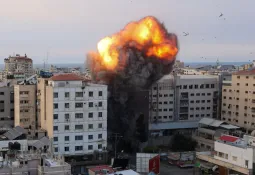
A house or store fire is no longer a passing event that can always be explained by an electrical fault, simple negligence, or pure coincidence. When fires recur in similar contexts, appear in specific properties, or are linked to people whose names repeatedly surface in the background, it becomes natural for questions to go beyond the apparent. Incidents, no matter how many, do not follow the same pattern without a connection, nor do their details intertwine in this way unless there are hidden reasons driving them, subtle threads linking them, or motives not immediately apparent to the public. These questions have gained special importance recently, after the incident of a large house fire that raised many question marks due to the nature of the property, the timing of the fire, and the financial and social backgrounds surrounding the place.
The timing of the fire itself may be a message. Incidents that occur late at night, or at moments when the streets are empty, or at times when the chances of witnesses are low, cannot be separated from the possibilities of deliberate action. In the world of investigations, timing is not just a coincidence but an indicator that may guide the course of analysis. The perpetrator who plans an intentional fire often chooses a time that allows movement without attracting attention and gives an opportunity to withdraw from the place unnoticed.
In many cases, fires do not ignite without precedents; sometimes they are preceded by phrases, behaviors, or verbal and behavioral signals that reveal a state of tension, distress, or disputes that may reach the point of explosion. A person may express dissatisfaction with burdensome financial obligations, or reveal a desire to get rid of a failed project, or issue veiled threats in a moment of anger. These words may seem fleeting at the time, but after the fire occurs, they gain meaning and become part of an analytical thread that cannot be ignored.
If we look back a little and examine the record of properties linked to the involved parties, a recurring pattern may appear that cannot be described as coincidence. A place that witnesses a fire once and then again, or an owner around whom similar incidents recur, should be the focus of a thorough investigation. History in such cases is not just an archive but a potential guide that helps reveal whether the present is an extension of previous behaviors or undisclosed motives.
Here, the role of the owner emerges as the party most connected to the property. This person may be a victim, a beneficiary, or a party entangled in a complex network of relationships. Assessing their situation, behavior, and financial and social backgrounds becomes an urgent necessity in any honest investigation. Among what sometimes draws attention is the sudden change in the financial status of the parties involved. When a large construction project or a luxurious house appears that does not match the previously known economic situation, questions multiply automatically: Where did the money come from? What is the source of funding? Is there a hidden entity behind the financing? And is this related to the fire in any way?
The matter becomes more complicated when gaps appear in the flow of money that cannot be easily explained. There are cases where construction projects are used as fronts for money laundering or recycling, especially when the financing is disproportionate to the declared situation. Here, it is legitimate to ask: Did unknown-source money enter the construction process? Is there a potential link between this money and illegal activities such as drug trafficking, arms trade, car theft, or insurance fraud? Does the property form part of a network exploiting real estate projects as a cover to recycle money that cannot pass through the traditional financial system?
The legality of declared loans and financing must also be part of the investigation, as some loans may be just a cover to move money from unclear sources. Hence, the importance of comparing the loan amount with the actual financial situation of the borrower, examining the timing of obtaining it, and knowing whether it was actually used in construction or in undisclosed channels.
In an era of advanced cameras and phones that record every movement, analyzing movements around the property before the fire has become an essential part of any investigation. Who frequented the place? Did specific vehicles appear repeatedly? Were there visits at unusual times? These details, which may seem simple, can reveal a lot. Fire may consume the place, but it cannot erase what the lenses recorded beforehand.
Understanding the nature of relationships between the owner and the people who frequent the property is also important. There may be repeated meetings with unknown individuals or unjustified visits indicating a network of relationships that needs analysis. Here, another highly sensitive question arises: Is the apparent owner really the true owner, or is there a “hidden owner” managing affairs from behind the scenes? Illegal real estate practices often rely on apparent fronts that hide the real influential and wealthy owners.
Another legitimate question relates to the economic status of people involved directly or indirectly. Do some of them receive government assistance for low-income individuals or support based on claimed disability? If so, how can this supposed status be reconciled with owning large properties or building high-cost projects? The contradiction between declared income and visible assets may indicate undisclosed additional money or parties financing from the background.
Equally important is the possibility of conflicts between the owner and some individuals registered as dangerous or under legal surveillance. These conflicts may be a motive for revenge, pressure attempts, or financial extortion. In other scenarios, the owner himself may be part of a larger network, making the case more complicated than it appears.
If investigations reveal, or even suggest, that some of these fires were not accidental but deliberate, the seriousness of this type of crime goes beyond mere material losses. A deliberate crime disguised as an “accident” is one of the most dangerous types of crime because it exploits legal loopholes and reproduces itself repeatedly. Here, the problem of the bail system arises, which—despite expected amendments—has not yet reached a level that deters professional criminals who use fire as a tool to gain profits or erase traces. These individuals exploit system loopholes to temporarily escape punishment, then return again without real deterrence. This flaw is not just a legal problem but a poisoned dagger in the side of the national economy and national security; crimes targeting the real estate and economic infrastructure do not stop their effects at the fire’s boundaries but extend to threaten public trust and social stability.
In the end, the issue is not about one fire but a whole system of questions that must not be left unanswered. The fire may be extinguished in hours, but the roots of the truth may run deep and only a bold, impartial, and neutral investigation can uncover them. With every question raised, the investigation moves a step closer to knowing whether what happened was fate… or indeed a well-planned act cleverly hidden behind thick smoke.








Sunday, 19 July 2026
Loading...
--°C
--°C
- --%
- -- kmh
- --%