
Arab Canada News – News for the Arab Community in Canada
News
Between Calm and Anxiety: Gaza on the Edge of Transformation and the Difficult Labor of Peace
From the ceasefire to the test of international will

Published: October 15, 2025
The calm in Gaza, as formulated in the late September 2025 plan, appears to be more than just a ceasefire agreement or a temporary truce between two wars. It is an attempt to rearrange the political and humanitarian landscape in a region exhausted by wars and where trust among all parties has eroded. The plan came at a pivotal moment when the American administration realized that continuing the war was no longer politically or morally feasible, and that the cost of violence and deepening hatred had become heavier than any fleeting gain. This shift in the American stance, led by President Donald Trump's administration, was driven not only by humanitarian motives but also by a realistic reading of the features of a rapidly changing world and a new regional equation that is reshaping relationships and interests within and beyond the Middle East.
It is also clear that Washington no longer views Gaza merely as a battlefield but as a key to broader stability that ensures an organized withdrawal from the region's burdens without a complete loss of its influence. Therefore, the American calm plan was fundamentally different from its predecessors, as it opened the door to a multilateral consultation including Egypt, Saudi Arabia, Qatar, Turkey, and Pakistan, in a scene reflecting the decline of American monopoly over the Palestinian file and the beginning of a more shared and flexible diplomacy.
At the same time, the Canadian position emerged as a distinct Western voice, clearly expressing the necessity to move from conflict management to recognition of rights, affirming that the establishment of an independent Palestinian state is a condition for achieving security and stability, not a threat to them. With increasing international recognition of Palestine, it seemed as if the collective Western awareness was slowly moving out of the circle of blind bias into a broader space of mutual understanding of the responsibility of justice in achieving peace. This shift, although still limited so far, marks a change in the moral depth of some countries' positions that have realized that justice is not a burden on politics but a condition for its survival.
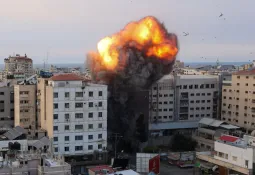
However, the path to sustainable peace remains fraught with obstacles, as between written texts and verbal promises stands a fragile and complex reality, burdened with suspicion and lack of trust. The real challenge does not lie in declaring intentions but in the ability to turn them into actionable commitments. The field in Gaza is so fragile that any minor breach is enough to reignite violence, and the humanitarian environment there teeters on the edge of total collapse, where human suffering intersects with political calculations in a closed circle.
At the political level, the internal Palestinian division remains one of the most dangerous obstacles to any settlement. The conflict between Fatah and Hamas still divides geography and decision-making, giving external forces a constant excuse to postpone or undermine solutions. A state cannot be built on divided land nor can trust be restored among a people whose factions dispute the legitimacy of representation. Without a genuine national reconciliation that restores Palestinian decision unity, any agreement will remain fragile, any talk of statehood incomplete, and peace itself merely a postponed truce.
On the humanitarian and economic level, the challenge is no less serious. Rebuilding Gaza is not an engineering task measured by the number of buildings to be constructed but a project of human renaissance that restores people's ability to dream and gives them confidence that peace can yield a better life. A people living amid rubble and hunger cannot believe promises nor defend a peace whose impact they do not feel in their reality.
Hence, the responsibility of the parties sponsoring the initiative, from Washington to the Arab and Islamic capitals, emerges. Peace is not made by conferences alone but by managing disputes before they turn into crises and by creating a real follow-up mechanism that ensures commitment and deters violations. These parties must move within a unified coordinating framework, away from calculations of influence and competition. The United States must also understand that its role is no longer that of a guardian but a partner within a new system involving regional powers, while Arab countries bear the responsibility of translating their political support into practical steps on the ground, whether by launching reconstruction projects, supporting comprehensive Palestinian reconciliation, or protecting the truce from collapse.
Western capitals, along with Canada and other Western countries, have realized that the continuation of the war in Gaza is not only a threat to the Palestinians but a direct danger to global stability and economy. Every new round of violence disrupts energy markets, weakens confidence in the international economy, and reminds everyone that stability in the Middle East is part of the stability of the global economic system. Therefore, recognizing the Palestinian state is no longer a luxury of choice or diplomatic courtesy but an urgent necessity to protect broader global interests, as security cannot be separated from justice, nor economy from politics, nor development from human dignity.
What is happening today in Gaza is a test of the international community's will and its ability to transform this calm from a temporary truce into the beginning of a realistic and comprehensive political path. Either this moment is invested to correct the course of history, or it will be lost as many opportunities were lost before. Peace is not built on good intentions alone but on sincere action, shared will, and the ability to see the future with eyes that transcend wounds.
Perhaps Gaza today, despite its destruction, is the beginning of a new phase in the awareness of the region and the world, as it is no longer possible to ignore that justice is the only path to security and that peoples are not defeated when they possess their rights, even if their homes are destroyed. If efforts succeed in turning the calm into a just and lasting path, Gaza will be a gateway to a different peace, a peace not dictated from outside but written by a collective will stemming from the conviction that dignity is the foundation of stability and that the human being is the primary goal of every noble policy.









Sunday, 19 July 2026
Loading...
--°C
--°C
- --%
- -- kmh
- --%