
Arab Canada News – News for the Arab Community in Canada
News
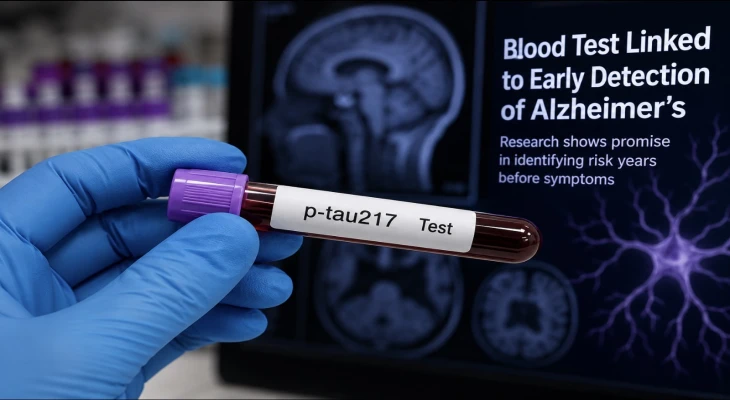
A blood test may reveal the risk of Alzheimer's years before symptoms appear
An increase in the protein "p-tau217" was associated with a higher likelihood of developing cognitive impairment within five to ten years, but the test has not become a routine screening tool
Published: July 25, 2026
A large international study showed that a simple blood test may help in the future to identify elderly people most at risk of developing Alzheimer’s disease symptoms years before memory and thinking problems begin.
The test detects the level of a protein known as «phosphorylated tau 217» or «p-tau217», which is associated with pathological changes occurring in the brain with the accumulation of «beta-amyloid» plaques and «tau» protein tangles, two of the most prominent biological markers linked to Alzheimer’s.
Researchers found that people with very high levels of this marker in their blood were more likely to develop cognitive impairment in the following years, even if they showed no noticeable symptoms in memory or thinking at the time of testing.
However, experts emphasized that the results do not mean the test can confirm that a healthy person has Alzheimer’s, or accurately determine when symptoms will appear, and it is currently not recommended for screening people without cognitive problems.
Study included about 2,700 people
Researchers analyzed data from 2,684 elderly individuals, with an average age of about 70 years, who showed no signs of cognitive impairment at the start of the study.
The participants came from six research groups and long-term clinical trials in North America, Japan, and Australia, and underwent blood tests to measure «p-tau217» levels, alongside periodic assessments of memory, thinking, and ability to perform daily activities.
Researchers followed the participants for an average of nearly five years, while some were followed for more than a decade.
During the study period, about 478 participants developed varying degrees of cognitive impairment, including mild cognitive impairment, dementia, or ongoing clinical changes indicating the beginning of cognitive decline.
Higher risk with elevated protein
The results showed that people with «p-tau217» levels more than twice the average recorded in the study faced an estimated 38% risk of developing cognitive impairment within five years.
The estimated risk rose to 78% over ten years, although researchers cautioned that the number of people followed for a full decade was limited, making the five-year estimates more reliable than the long-term predictions.
People with protein levels slightly above average had about a 15% risk of cognitive impairment within five years and 45% within ten years.
Conversely, very low levels of the marker were associated with a lower likelihood of developing cognitive problems during the follow-up period.
The results indicate a gradient of risk, as the test result does not simply divide people into affected and unaffected, but may help estimate a person’s position within a biological pathway that gradually develops over years.
What does the test measure?
Alzheimer’s is associated with the accumulation of two main types of abnormal proteins in the brain.
The first is «beta-amyloid», which accumulates as plaques between nerve cells, while the «tau» protein accumulates inside cells as tangles that disrupt their function and cause gradual cell death.
The «p-tau217» test measures a modified form of tau protein found in the blood, whose levels typically rise in parallel with increasing Alzheimer’s-related changes in the brain.
The test alone does not indicate the extent of damage to memory or a person’s ability to perform daily life activities, but it may provide an indicator of how far the biological process of the disease has progressed before symptoms become apparent.
Researchers found that the test result provided additional information about future risk even after accounting for brain imaging results and known genetic factors.
Not a definitive diagnosis
Despite promising results, elevated «p-tau217» cannot conclusively determine whether a person will develop dementia.
Some people may carry Alzheimer’s-related biological changes for many years without severe symptoms, while others’ memory may be affected by vascular diseases, strokes, or various neurological disorders.
The marker levels can also be influenced by factors including age, genetics, kidney function, obesity, and racial and health background.
Therefore, the result should be interpreted within a comprehensive medical evaluation that includes symptoms, medical history, and cognitive tests, and may involve imaging or additional tests when necessary.
A risk percentage of 38%, for example, does not mean a person will definitely develop the disease, but that about 38 out of every 100 people with similar results developed cognitive impairment within five years in the study data.
No recommendation for screening healthy individuals currently
Measurement of «p-tau217» is currently used to help evaluate people who already have memory or thinking problems, to determine whether Alzheimer’s-related changes may be causing their symptoms.
Its use to predict the future in someone without symptoms is still under research.
Experts believe that testing healthy individuals may cause significant anxiety without providing a clear treatment decision, especially since there is no approved preventive treatment that can be offered to everyone before symptoms appear.
The test has not yet reached the accuracy needed to tell a specific individual with certainty that they will develop Alzheimer’s or to determine the year symptoms will begin.
Therefore, researchers do not recommend healthy people request the test solely because of a family history of the disease, unless it is part of a scientific study or after specialized medical evaluation.
Potential importance for preventive trials
The most immediate benefit of the test may be helping researchers select people at highest risk to participate in trials testing drugs or strategies aimed at delaying Alzheimer’s before symptoms appear.
These trials need to identify people who have begun biological changes of the disease but are still able to think and function normally.
Following thousands of people for years to see who develops symptoms can be time-consuming, while a blood test can help focus studies on higher-risk groups and speed up evaluation of preventive treatments.
If ongoing trials prove that starting treatment during the silent phase of the disease can delay cognitive decline, blood testing may become a future tool similar to cholesterol or blood pressure measurement, not only for diagnosing the disease but for estimating risk and choosing the timing of intervention.
What can be done now?
Currently, the test results do not change general health advice related to reducing the risk of cognitive decline.
Recommendations include maintaining physical activity, following a balanced diet, getting good sleep, treating high blood pressure, diabetes, and cholesterol, avoiding smoking, and maintaining social and mental activity.
These measures do not guarantee prevention of Alzheimer’s but support brain and heart health and may reduce factors contributing to dementia or accelerate symptom onset.
People who notice ongoing changes in memory, language, or ability to manage daily affairs are advised to see a doctor rather than rely on a single blood test or commercially available tests without medical interpretation.
The study represents an important step toward moving from detecting Alzheimer’s after symptoms appear to estimating risk during early stages, but it also confirms that knowing the biological marker is not a substitute for medical diagnosis, and its widespread use will require further studies and effective early treatments.
The study included 2,684 cognitively healthy people, and a marked increase in «p-tau217» was associated with an estimated risk of 38% over five years and 78% over ten years, with researchers warning that ten-year follow-up data were less abundant and that the test is not currently recommended for asymptomatic individuals.














Saturday, 25 July 2026
Loading...
--°C
--°C
- --%
- -- kmh
- --%