
Arab Canada News – News for the Arab Community in Canada
News
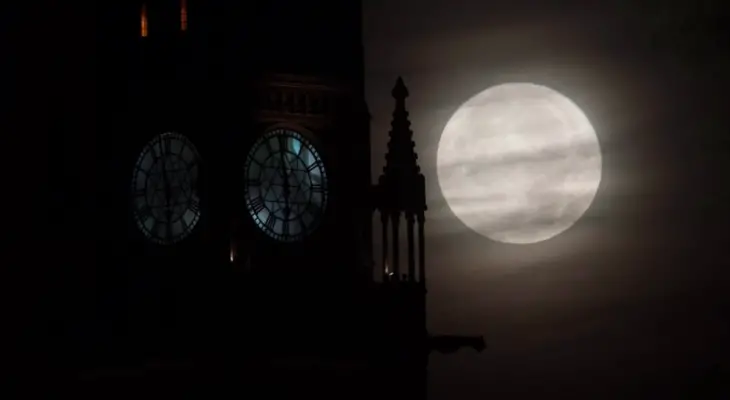
The largest supermoon in 2025 decorates the Canadian sky this week
"Beaver Moon" reaches its peak at dawn on Wednesday with brightness exceeding the usual full moon by 30% and a rare close approach to Earth
Published: November 4, 2025
Canada is witnessing this week a distinctive astronomical phenomenon represented by the largest Supermoon of 2025, known as the «Beaver Moon», which will reach its closest point to Earth at dawn on Wednesday, November 5, appearing in its most magnificent and brightest form of the year.
According to the Canadian Meteorological Agency and international space observatories, the moon will be about 356,980 kilometers away from Earth at the moment of lunar perigee, approximately 26,000 km closer than the usual average, making it appear 14% larger and about 30% brighter compared to a regular full moon.
It is called the «Beaver Moon» according to the traditions of the indigenous peoples of North America, who associated its appearance with the period when beavers build their dams in preparation for winter.
Best time for observation
Residents of Canada can watch the phenomenon in its clearest form on the evening of Tuesday, November 4 until the morning of Wednesday, November 5, when the moon begins to rise above the eastern horizon shortly after sunset. It is recommended to choose open locations with a wide horizon such as lake shores or rural areas far from light pollution.
Astronomers indicate that the best moment for photography will be around 6:00 AM Eastern Time, when the moon reaches full completion, although the most visually beautiful scene is often at sunrise or sunset due to the optical illusion that makes the moon appear larger near the horizon.
A recurring astronomical phenomenon but rare in size
The «Beaver Moon» is the second of three supermoons witnessed in 2025, but it is the largest ever. The first appeared last May, while the third supermoon is expected to appear next December, but the November moon will be the closest to Earth since 2019.
Scientifically, a supermoon is defined as a full moon that coincides with its approach to Earth at the perigee point in its elliptical orbit, making it appear larger and brighter than a regular moon by between 10 and 30%.
Recommendations for observation and photography
Astronomy experts advise those interested in photography to use long lenses (200 mm or more) to get a close shot of the moon during its rise or set, with the camera fixed on a tripod to avoid shaking. Amateurs can also enjoy the scene with the naked eye to appreciate the beautiful view that will repeat at this size after several years.
Weather forecasts in most Canadian provinces indicate clear skies or light clouds in most eastern and central areas on Tuesday night, providing an ideal opportunity for astronomy enthusiasts to observe this unique phenomenon.
Scientific background
The supermoon phenomenon results from the conjunction of the full moon and its proximity to Earth in its elliptical orbit, as the lunar perigee occurs approximately every 27.55 days. When this approach coincides with the moment of the full moon, sunlight reflects off its surface at nearly 100%, making it appear brighter and clearer to the naked eye.
Astronomers at the Canadian Space Agency (CSA) confirm that such phenomena have no direct geological effects on Earth, but they attract wide interest among observers and photographers worldwide due to their unique beauty and the possibility of observing them without specialized equipment.














Sunday, 19 July 2026
Loading...
--°C
--°C
- --%
- -- kmh
- --%