
Arab Canada News – News for the Arab Community in Canada
News
Palestine at the Toronto Festival: The Pain of the Present and the Memory of the Past on the Big Screen
When Canadians cry for Gaza
Published: September 20, 2025
Mabrouka Alghanmi, Toronto:
In the golden jubilee edition of the Toronto International Film Festival, Arab cinema appeared in its finest form, asserting an exceptional presence on the global map. Amid hundreds of screenings from the five continents, the voice of Palestine rose loudly through two films that made the event: «The Voice of Hind Rajab» by Tunisian director Kawthar Ben Hania, and **«Palestine 36»** by Palestinian director Annemarie Jacir.
As a Tunisian journalist residing in Canada, I had the opportunity to follow this pivotal cinematic moment from the heart of Toronto, where the screenings were not just artistic events but emotional encounters and deep dialogues about history, memory, and human suffering.
"The Voice of Hind Rajab": Gaza that made Toronto cry and shook Hollywood
Kawthar Ben Hania, who returned from the Venice Festival with the Silver Lion award, presented one of the most impactful films of the festival in Toronto. Her film "The Voice of Hind Rajab" is not just a cinematic work, but a compelling testimony about Gaza, narrating the daily pain under siege, and holding up a mirror of conscience to the world.
The special screening in Toronto was exceptional: the hall was packed with audiences, including a large Palestinian presence who came to closely follow the film. The meeting between the audience and the film’s heroine, Saja Al-Kilani, turned into a profound human moment; dozens approached her, some embraced her while crying, in a scene that summarized how cinema meets memory and emotion.
Most of the audience left the hall with tears in their eyes, in one of the strongest moments experienced by the festival. We tried to survey the opinions of some attendees who expressed their admiration for the cinema presented by the director and said it was real cinema that touches the soul and makes a difference. Thus, The Voice of Hind Rajab continues its global journey after shaking Hollywood itself, with stars Joaquin Phoenix and Brad Pitt joining the list of executive producers, a step that showed global support for the humanitarian cause raised by the film.
«Palestine 36»... reclaiming memory before the wound
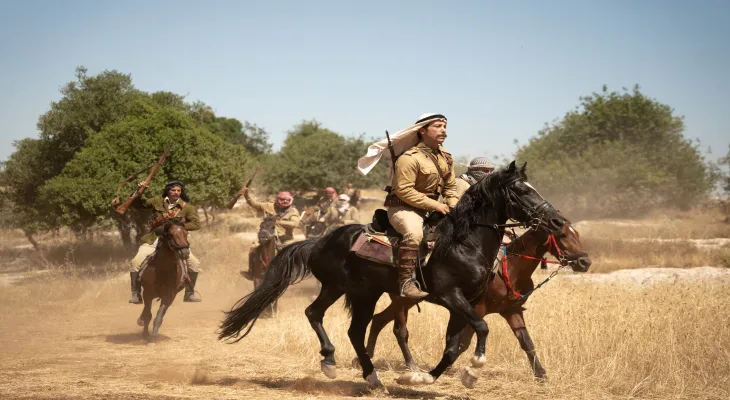
On the other side, the film Palestine 36 by director Annemarie Jacir offered a different vision. Jacir chose to return to the 1930s, that is, to Palestine before the occupation, to reconstruct the image of a society that was vibrant, rich in its culture and velvet community.
The work relied on rare archival materials and stunning visuals, depicting details of daily life from popular markets to social gatherings, from traditional architecture to elegant fashion.
The Canadian and Arab audiences alike warmly received the film. Many said it opened their eyes to a page of Palestinian history rarely shown on screen, as if restoring recognition to a time stolen from collective memory.
Dialogue with the film’s stars
During the festival, I met the film’s stars Dhafer L'Abidine and Yasmine Al Masri, and the conversation with them was a window to understand the depth embodied in this work.
Dhafer L'Abidine said: «To understand the Palestinian reality today, one must return to history. This film does not present a distant story, but lays the foundation for understanding everything that followed. Without that memory, we become prisoners of the present moment only.»
As for Yasmine Al Masri, she expressed her conviction that «the film is a historical document presenting a truth unknown to many about the velvet Palestinian society before the occupation. For me, it was important to participate in a work that highlights the aesthetics of a place buried from memory.»
The words of the two stars clearly reflected the philosophy of the work: it is not just a retrieval of the past, but resistance to the erasure of identity through cinematic imagery.
From Toronto to the Oscars
Both films transcended the boundaries of the Toronto Festival; they were chosen to represent their countries in the upcoming Oscars race: "The Voice of Hind Rajab" for Tunisia, and **"Palestine 36" for Palestine**. A step carrying strong symbolism: that Arab cinema has imposed itself on the highest platforms, and that Palestine – with its history and present – has become an integral part of the global cinematic narrative.
Cinema as memory and resistance
In the halls of Toronto, Palestine was not just a political news item or fleeting media material, but a human face appearing on the screen to engage the collective conscience. Between the tears of the audience at the screening of "The Voice of Hind Rajab," and the retrieval of history in "Palestine 36," it seemed that cinema was no longer just an art, but a field of resistance, a tool to reclaim the narrative, and a memory that preserves what history tries to erase.













Sunday, 19 July 2026
Loading...
--°C
--°C
- --%
- -- kmh
- --%
Comment has been disabled for this news