
Arab Canada News – News for the Arab Community in Canada
News
Discovery of a lost continent between Canada and Greenland that formed 60 million years ago
Published: July 20, 2024
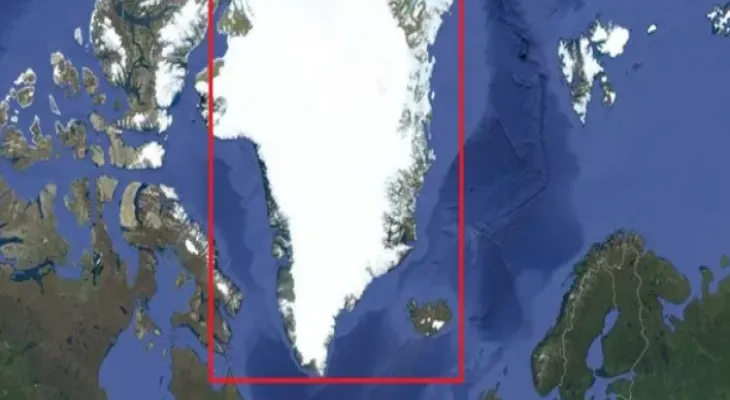
Researchers at the University of Derby in the UK accidentally discovered a landmass over 400 kilometers long beneath Davis Strait, between Canada and Greenland, while studying the tectonic movements of the plates in the area.
The researchers explained that the newly discovered small primary continent of Davis Strait is a tectonic mass that has become a separate continent and formed during "a long period of rifting in the seabed between Greenland and the North American continent."
Dr. Jordan Veithian told the physics site "Phys.org": "Rifting and the formation of the small continent are ongoing phenomena, with every earthquake."
The researchers identified the new small continent using a combination of data on crustal thickness derived from gravity maps, seismic reflection data, and tectonic plate modeling.
The gravity maps contain information about the density of rocks and the depth and distribution of anomalous source rocks.
The team focused on how the crustal anomaly formed by reconstructing tectonic movements that have lasted for approximately 30 million years.
They described the small primary continent as being larger than other small continents, with a thickness ranging from 17 to 23 kilometers, and said that understanding how it formed is vital for ongoing science today.
The average thickness of a small continent is typically between 5 to 25 kilometers.
Mapping techniques traced how seabed movements have changed over millions of years and identified "an isolated landmass with relatively thick continental crust that separated from Greenland during a recent phase of extension [from east to west] along western Greenland," according to the American site "Space."
The researchers stated that Davis Strait is one of the largest collections of known fault structures with well-defined changes in plate movement that can help understand how microcontinents form.
According to the study, the initial rifting between Canada and Greenland began approximately 118 million years ago, but the seabed did not start to extend until 61 million years ago to form what is known today as Davis Strait.
After about 3 million years, scientists reported that seabed extension shifted from northeast to southwest, leading to the formation of the small primary Davis continent.
The shift lasted for around 33 million years and only stopped when Greenland collided with Ellesmere Island to the north.
The researchers expressed hope that the findings they achieved will be used to understand how other small primary continents form around the world, including the small "Jan Mayen" continent northeast of Iceland and "Golden Drak Noll" off the west coast of Australia.











Sunday, 19 July 2026
Loading...
--°C
--°C
- --%
- -- kmh
- --%