
Arab Canada News – News for the Arab Community in Canada
News
After a decade... nearing completion of the marine facility in the Canadian Arctic this season.
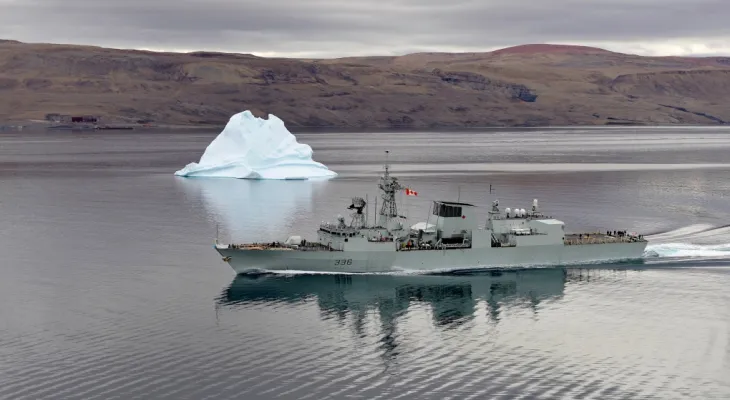
Published: June 28, 2024
After nearly a decade past the scheduled date, the long-promised maritime fuel station by the Canadian military in the High Arctic region may open as early as this summer, albeit with restrictions on the facility's operations and serious questions regarding its long-term viability.
The Department of National Defence states that contractors at the $115 million Nanisivik naval facility are still repairing valves, painting buildings, and replacing pipes before the naval base, located on the northwestern coast of Baffin Island, can become operational.
National Defence spokesperson Frederica Dubois described the work as "minimal," stating in an email this week that the facility "could be completed this season, pending contractor confirmation."
However, the construction season in the Arctic is short and the potential operating window for the facility will close by the end of summer, leaving the navy's new Arctic patrol vessels without a local refueling station in the far north for at least another year.
Adding to the uncertainty, the Department of National Defence has yet to find suitable contractors to bring in fuel and operate the site. The department says officials are still evaluating the needs of the new Arctic patrol vessels before issuing a request for proposals.
Unheated fuel limits operations
Any marine fuel that eventually arrives at Nanisivik must be introduced at the beginning of the operating season in late August.
Once the fuel reaches the site, it must remain in the facility's storage tanks for at least 48 hours before samples can be flown to Ottawa for testing— a process that will take about a week to complete, according to Dubois.
Once Ottawa approves the fuel, the Nanisivik facility will have about four to five weeks to replenish Arctic vessels before the weather forces the facility to close for the season.
Dubois stated, "Depending on temperatures in late September, the fuel could start to condensate due to the unheated fuel tanks and lines, limiting the navy's ability to use the fuel. At that time, the fuel must be transferred from the tanks."
Additionally, an agreement between the military and the Government of Nunavut will prevent any marine ice near the facility from being broken to protect wildlife and maintain local access to the frozen waters, according to both Dubois and the 2022 Auditor General's report on Arctic security.
The Auditor General's report noted that "for the rest of the navigation season, replenishing fuel for ships will continue to rely on commercial options or ally cooperation."
"This leaves the navy at risk of not being able to replenish its vessels wherever and whenever needed."
COVID-19 and weather increases delays
It was originally envisioned as a deep-water port and year-round operating airstrip, where Canada would assert its sovereignty over the Arctic territorial waters, including the Northwest Passage, and Prime Minister Stephen Harper announced the new facility in 2007, coinciding with his government's commitment to build eight Arctic patrol vessels for the navy.
The facility was scheduled for completion by 2015, but the project was scaled back when its expected budget exceeded $258 million.
Today, the site plan includes unheated fuel storage tanks, a site office, a wharf operator's shelter, a helicopter landing pad, and an unheated storage building.
The existing wharf underwent minor repairs to accommodate Arctic patrol vessels and any other government ships needing refueling.
Construction finally began at the site in 2015, but inclement weather and the COVID-19 pandemic caused further delays in an already short construction season in the area.
In 2021, with little to no construction happening due to pandemic travel restrictions, the road connecting the Nanisivik facility to the nearest operational airport in the Arctic Bay, Nunavut was washed out.
Dubois said, "The contractor was unable to bring heavy vehicles across the bridge, and could not access the work site for the 2021 construction season."
"The road was deemed safe for use in 2022, allowing work to resume while continuing to manage pandemic restrictions during that time."
Expert says Nanisivik site is wrong
Retired Colonel Pierre Leblanc, who previously led Canadian forces in the north and now serves as a consultant on Arctic security, stated that the Nanisivik project was doomed from the start.
The Nanisivik facility is located about 100 kilometers south of the Northwest Passage, the disputed sea route between the Atlantic and Pacific Oceans, which Canada has long claimed sovereignty over.
For years, Leblanc has advocated abandoning the Nanisivik project in favor of establishing a marine port and border monitoring about 350 kilometers away in Resolute Bay, a well-established community with a larger airport directly on the crucial Arctic shipping route.
It is also already home to the Canadian Forces Training Centre in the Arctic, which is a permanent military base specializing in northern operations, and other federal agencies maintain a presence there, including the RCMP and Natural Resources Canada.
Leblanc said in an interview this week, "So anyone crossing the Northwest Passage, which is still an internationally disputed area considered Canadian internal waters, would have to navigate through a basically federal security and military facility."
As a former commander in the Arctic, Leblanc says he routinely managed scenarios with Canadian forces involving foreign ships transiting the passage, either carrying weapons for hostile nations or looting Canadian natural resources, to test the military's ability to assess and respond to a crisis in the Arctic Sea.
He said, "The questions at the time were: Would we know that it was happening? And the answer was no. Would we be able to do anything about it? And again, the answer was no."
Shipping traffic in the Arctic is expected to grow in the coming years, a fact that recent Canadian defense policy highlights as a priority for national security.
Defence Minister Bill Blair wrote in the preface to the current policy released in April: "By 2050, the Arctic Ocean may become the most efficient shipping route between Europe and East Asia."
He added: "As the Arctic becomes more accessible to foreign entities, we need to ensure that our military has the tools necessary to assert our sovereignty and protect Canada's interests."
The Department of National Defence reports it has spent approximately $107.6 million of the expected $114.6 million budget for the Nanisivik facility so far.














Thursday, 18 June 2026
Loading...
--°C
--°C
- --%
- -- kmh
- --%