
Arab Canada News – News for the Arab Community in Canada
News
Gaza… continuous pain
A never-ending story at the limits of survival

Published: April 26, 2026
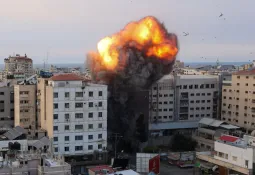
The moment of arrival in Canada was not the end of the story as many thought, but rather the beginning of a new chapter, more complicated and more burdensome on the soul. When the families coming from Gaza set foot on safe ground, they thought—if only for a moment—that they had left behind everything that weighs on the heart: the roar of planes, the smell of death, the images of loss that never leave the memory. However, the truth soon revealed itself; pain does not end with survival, but reshapes itself and quietly seeps into the details of daily life, where it becomes more hidden… and more painful.
In every home, there is a story of waiting, where a mother sits silently watching her son. His papers are scattered in front of him, and his eyes are fixed on merciless numbers. Talking about university is no longer a simple dream as it once was. The tuition fees imposed on him as an "international student" stand as a solid wall between him and his future. He who survived a war he did not choose now finds himself facing another battle—a different kind of battle, where the sounds of shells are not heard, but it is measured by numbers, ability, and waiting.
Calculations run nonstop in his head: How much does he need? How much is missing? And how long can he wait before the train leaves him behind? Between every question and another, a heavy feeling creeps in that time is not on his side, but ahead of him with steps he cannot catch up to.
The mother then realizes, through her deep silence, that the safety they have reached is not yet complete. True safety is not just surviving death, but being given a chance to live with dignity, and to see her children walk confidently towards a clear future. But this path seems foggy today, full of obstacles no less harsh than those they fled from, but obstacles that push them into the unknown without a clear time frame. As if life, after saving them, decided to test their patience in another way.
In the evening, a heavy silence prevails inside these homes. It is not the silence of comfort, but the silence of exhausting thinking. No easy decisions can be made. Should they hold on to staying in Canada, where there is safety but limited opportunities? Or do they think about returning, despite all the risks it carries, just because the horizon here seems closed to their children's dreams?
It is a struggle not spoken aloud, but present in every detail even in their meetings, as they only talk about their deep worries: in the father's gaze weighed down by helplessness, in the mother's anxiety she tries to hide, and in the eyes of the children who feel that time is passing without them. A school year is lost, and another looms on the horizon, while they stand at the starting line, unable to move forward.
Around them, others continue their lives normally. New friends plan to enter universities, talk about their majors and ambitions, while they are stuck between conditions they cannot meet and a reality that does not allow them the chance to delay. Here, loss is not just the loss of place, but the loss of the natural rhythm of life, and the loss of the ability to catch up with what is obvious to others.
And in other places, outside Canada, other families await their turn to arrive. In Cairo and other cities, they carry the same hope and paint an ideal picture of survival. They believe that reaching safety is the beginning of the road to an open future. But the news they receive from their relatives here confuses this picture; safety exists, yes, but it is incomplete, as if the dream itself needs someone to complete it, not to be left hanging halfway.
These stories have begun to reach the ears of some officials, and attempts have appeared to seek solutions. But the nature of this suffering cannot tolerate delay. Time, for these people, is not just a passing factor, but a daily pressure element that steals from their lives opportunities that cannot be easily compensated. Every day that passes without a solution is an additional distance widening between them and a future they thought was near.
What is required is not miracles, but fair decisions that realize these cases are not ordinary. That these young people be treated in a manner befitting their exceptional circumstances, that the doors of education be opened to them as they are to others, and that their studies be seen as the cornerstone in rebuilding their lives, not an additional burden increasing their suffering.
Education here is not a luxury, but the only bridge to true stability. Without it, safety remains incomplete, and life hangs between what was and what should be.
In the end, the story remains simpler and deeper than it appears. It is the story of families who survived the war, but are still searching for a life full of meaning. The story of children who want nothing more than a fair chance to be like others—no less and no more. And the story of hope that has not extinguished, but has become fragile, waiting for someone to protect it from fading before it is too late.
Gaza, for them, is no longer just a place… but a feeling that dwells within them wherever they go. A continuous pain, even when they are in a land supposed to be the beginning of healing. Between incomplete safety and a postponed future, they stand on the edge of waiting, anticipating a moment that rearranges this world in their eyes, a moment in which they feel that their survival was not just a coincidence, but the beginning of a life worth living!.






Thursday, 02 July 2026
Loading...
--°C
--°C
- --%
- -- kmh
- --%